Through the Years, June 17
50 years ago
June 23, 1976
— Rainfall Was Needed, But Six Inches In Eight Hours Floods
This area needed rain, but six inches in about eight hours was more than streams and drainage ditches could handle. Weather predictions had a 30 percent chance for rain Wednesday, but storms slid into the area shortly after midnight Tuesday. Cloudbursts in the area produced heavy downpours. The storm was accompanied by heavy lightning but little wind. Officially, at the U.S. Forest Service 8 a.m. measurements were 3.29 inches. However, home gauges throughout the area had between five and six inches. Shell Knob reports said six-inch gauges were overflowing. Mary Ann Thomas, recorder at the Cassville Ranger District of Mark Twain, said average rainfall for June was about four inches. Previous to Wednesday’s downpours, .51 of an inch had been recorded here, and it was still raining at press time. A dry late winter and indications of June being without moisture had some agricultural interests concerned. In January this year the area had .39 of an inch, with .30 recorded in February. March had 3.33 inches, April 6.02 and May 5.63. Mrs. Thomas said this puts moisture to date at the station at 19.47 inches. Normal for a 12-month period in this area is somewhere around 40 inches. Traffic on Cassville’s Main Street was slowed but not closed due to Hawk Branch and Little Troublesome overflowing between 10th and 11th Street drainage ditches. At press time, Flat Creek was staying within its banks, but promises of additional moisture could produce flooding in some areas. Weather observers had issued no flood watches for this area. In fact, 6 p.m. forecasts failed to mention anything like the downpours being on their way into this area. Ponds that were beginning to show the effects of low moisture this month were once again brim full as a result of heavy runoff in the rains.
— State Plan Has $7.5 Million For Roaring River Projects
Roaring River State Park is included in a 10-year Missouri program for park expansion, according to announcements by James Wilson, director of the Department of Natural Resources. The overall program would call for expenditure of $36.6 million. Roaring River’s figure for improvement costs calls for $7,445,000 according to reports. The local park program calls for acquiring an undesignated area in southwest Missouri near Roaring River and Table Rock Lake to provide new area acquisition and development of 200-plus acres, with priority given to preservation of stream corridors or natural areas. This would cost an estimated $2,800,000. In addition, $4,645,000 is slated at Roaring River for major reorganization of use areas, including a new concession complex, expansion of camping facilities, demolition and renovation of outdated structures, new utility systems and general renovation of grounds; acquisition of 1,300-plus acres needed for expansion; purchase of conflicting in-holding uses; and trail development. State efforts to secure private property in the park last month resulted in a backing down by the Department of Natural Resources when commissioners set a $92,000 price tag on the commercial site owned by Mr. and Mrs. Roy Edmondson and leased by Mr. and Mrs. Gary Box. The state plan, probably necessitating a bond issue approved by the legislature, would put more money in the next 10 years into parks and recreation than has been spent in Missouri’s entire 155-year history, calling for total additions and improvements costing $201.1 million. Plans for expansion are being developed by a St. Louis firm. Under preliminary reports, 78,122 acres would be added to the system’s present 80,350 acres. The plan places a major emphasis on developing new recreational opportunities within the park system near Kansas City and St. Louis. Roaring River State Park presently contains 3,459 acres. The exact acquisitions intended by the plan are not available at this time from park sources. However, it is known the park system has eyed that area of the Roaring River stream that is between present park boundaries and Table Rock Lake or Eagle Rock. The last previous land addition to Roaring River was several years ago when the Conservation Commission acquired acreages up Dry Hollow. This addition was for the purpose of installing retaining structures to reduce flooding and gravel fill in the stream.
40 years ago
June 25, 1986
— Roaring River’s Ahead Of Record Setting Year’s Pace
If Roaring River State Park continues at the present rate of trout tag sales, the 1986 season will break existing records. In fact, the park is experiencing an outstanding year according to all departments. Targeted are the years 1980 through 1983, all which ran over the 100,000 mark for trout tag sales. The existing record of 106,924 was established in 1981. That year, the pre-July 4 figure stood at 48,204 anglers using the stream. As of Sunday, the number was running over 2,500 above that at 50,931, reported Charles Curry, hatchery superintendent. With the halfway mark of the eight-month season past, the park is running nearly 5,000 tags above the same period last year. Curry’s opinion of the increases are shared by concessionaire Jack Nickols. Both agree the water conditions have been good this year. Domestic travel increases are bound to be helping. Gasoline prices are a factor, along with ideal weather in this area. Nickols also said improvements to camping facilities have returned some folks who left Roaring River for other areas during construction stages. Cabin additions, renovations of the park motel and general improvements in the park are all helpers to bigger attendance figures. Curry said his crews had stocked over 115,000 fish during the half-season period. He said the fish weighed about 86,250 pounds and required nearly 129,275 pounds of feed. The hatchery crew includes assistant Skip Doak, Terry Fuller, H.E. Stephens, Marvin Farwell, Rod Tucker, Mac Thomas and Bill Murphy. Merle Rogers, park naturalist, said his department experienced the largest month of May on record. During that time frame, 3,133 persons used naturalist facilities, tours and programs. Assisting Rogers this summer in evening programs, games, nature and hatchery tours are seasonal naturalists Don Brink, Sharon Zielmann and Lisa Drysdale of Springfield and Karen Daldom of Aurora. Nickols said the overall accommodation increase of people at Roaring River amounted to about 12 percent. He said restaurant use was showing a considerably greater increase this year. Bill Ash, assistant superintendent at the park, said at the end of April the Missouri Department of Natural Resources reported a 20 percent increase in park use. Numbers of people were computed by the state at 34 percent above the previous year. Ash said May and June figures would follow about the same trend. Park officials said increases were expected to continue at Roaring River since coming months were the heavy-use times as visitors flock to the popular facility to take advantage of what’s available around the clear-running stream.
— OACAC Helped 870 Families With Program
“We were able to help 870 families with food at our May commodity distribution,” said Una Henderson, supervisor for the OACAC Barry County Neighborhood Center. OACAC distributes commodity foods to low-income families three times each year. Families receive cheese and butter, and a choice of honey, nonfat dry milk, cornmeal, flour or rice, depending on the number of people in the household. “People who want to receive commodity foods need to be registered with us,” said Mrs. Henderson. Families can register by providing three months’ proof of income for everyone in the household, and proof of Social Security numbers for everyone age 18 and over. “We will distribute food again in September,” said Mrs. Henderson, adding that those who already have registration cards should be sure to renew them if they expire before October. For more information about commodity foods, contact the OACAC Barry County Neighborhood Center, 200 E. Fifth, Cassville.
30 years ago
June 19, 1996
— Law enforcement officials recommend SK sub-station
About 100 people were present at the VFW Hall in Shell Knob Tuesday night, where Sheriff Ralph Hendrix of Barry County and Chief Deputy Richard Hill of Stone County agreed that the Shell Knob-Viola area needs a sub-station manned by a full-time deputy. The Shell Knob Chamber of Commerce sponsored the public forum for the purpose of exploring issues and resolutions to law enforcement difficulties in the area. All concerned agreed that monetary constraints in the sheriffs’ departments prohibit hiring an adequate number of deputies. Additionally, the fact that Shell Knob is so far removed from Cassville and Galena makes policing logistics complicated. This was supported by demographics and statistics provided by each official. Barry County has only eight deputies. Stone County has 11. One portion of the program had community volunteers reading questions prepared by the chamber’s law enforcement committee. Although Hendrix and Hill were not given an exact list of questions in advance, they were provided with an agenda along with a request to be prepared for particular statistical questions. Through these series of questions, it was determined that Barry County has a road officer assigned in the general Shell Knob area eight hours each day. Stone County has no one assigned but responds when called. Hill estimated that 2 percent of the calls made in Stone County originate in the Shell Knob-Viola area, while Hendrix reported 115 calls so far in 1996. Both officers confirmed that daily logs are kept, which verify each officer’s whereabouts and activities during their shift. Barry County has five reserve officers, and Stone County utilizes 15. A reserve officer must be certified but receives no compensation from the county. When questioned about application for federal and state grants to help provide additional deputies, equipment and implement new programs, Hill indicated that Stone County had been able to initiate its DARE program through a grant but stated no other plans to make applications in the future. Hendrix also said the Barry County DARE program resulted from a grant, but he has made no other application for supplemental funding. Both counties utilize drug task forces in their areas. Hendrix has also worked with the Missouri Department of Public Safety, and Hill recounted that Stone County called upon the South Central Major Case Squad in the Michelle Winter case. Hendrix and Hill agreed that Shell Knob needs a sub-station with a full-time officer assigned to it. Having that officer commissioned in both counties was their preference, thereby allowing the officer the freedom to operate without restrictions in each county. In order to achieve this, two things would have to occur: commissioners from each county would need to agree to fund the sub-station and deputy, and prosecution procedures would have to be defined. Presently, Barry County has a sub-station in Monett. A dually commissioned officer is shared between the two counties. Hill further suggested that Shell Knob could raise funds to help offset expenses if the commissioners would agree to support a sub-station. Questions and suggestions from the floor followed. One suggestion was to hire a secretary to type reports following arrests so that deputies do not have to spend their time typing when they could be on the road. Another audience member reminded those present that Shell Knob has a strong voter block and encouraged residents to use their voting power in upcoming elections. He emphasized that Shell Knobians must approach commissioners regarding the needs in Shell Knob. The Shell Knob Chamber of Commerce will sponsor two other forums in July. On July 16 at 7 p.m. in the VFW Hall, candidates for Stone County Sheriff will be invited to address the public. A similar meeting for Barry County candidates will be held July 23 at 7 p.m. in the VFW Hall.
— Master gardener volunteers her time to help other green thumbs
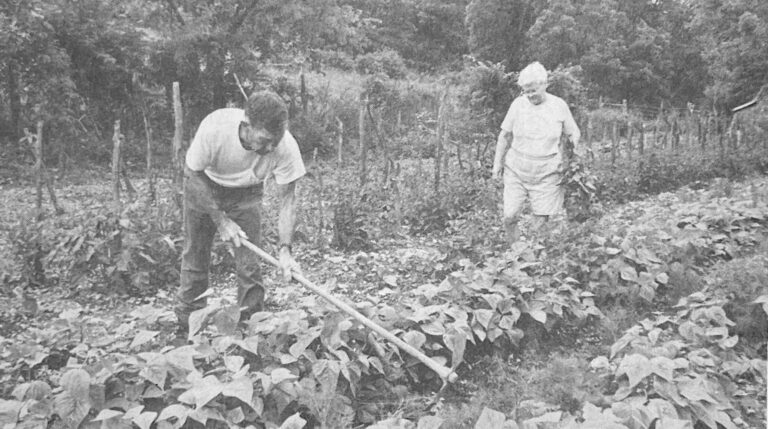
Spring has faded, and summer has finally arrived. Many area residents can now be seen bending over flower beds and gardens, ridding their plantings of pesky weeds. One Purdy woman is particularly serious about her gardening. Her name is Evelyn Hardwick, and she holds the title of master gardener. Hardwick gained her credentials four years ago when she enrolled in the master gardening program offered through University of Missouri Extension. Her instructors were people from the university and other specialists in various horticulture fields. The different speakers covered many areas, ranging from maintaining grass and fruits to identifying plant diseases. The university furnished a large notebook filled with material, and they continually add and delete from it to keep it up to date. To be recertified as a master gardener each year, Hardwick must volunteer 20 hours of community service. She can be found answering questions about plants at Wal-Mart or making gardening house calls. Hardwick said she usually receives approximately 50 to 60 calls during the summer. She said the most common calls this year have pertained to reviving plants after a harsh winter and late spring. Her solution — give them tender loving care, lots of water and a little pruning. Hardwick, who spends many hours working in her garden with her husband, Lee, said a common mistake is planting gardens too late. “We start planting our beets, cabbages and other vegetables in cut-off milk jugs in the house around March before we transfer them outside,” Hardwick explained. “So we’re already finished with some of our crops.” Another helpful gardening tip from the master gardener is to rotate your garden. “Don’t grow the same plants in the same spot every year,” she instructs. “It depletes the much-needed nutrients from the soil. If you plant your tomatoes in a certain spot one year, plant your green beans there the next year. This keeps the soil nice and rich.” Hardwick said she is more than happy to help others with their gardening.
— County will decide future of jail project
Barry County Commissioners have asked County Prosecutor David Cole to review a contract received from Branco Enterprises for the proposed expansion of the county jail. Bids for the jail project were opened on May 2. The lowest bids received were approximately $169,000 over budget when architectural fees were added. The county had earmarked $500,000 for the project. The commission decided to postpone awarding of a bid until they could discuss their options with Jim Lichty, architect. Branco was the lowest of five bids received from general contractors. The company’s bid was $371,000. Security equipment and detention modules make up the additional cost. A final decision on the future of the jail project is expected to be announced on June 20. The commission held a bid opening at their June 17 meeting. They received five bids on computer equipment for the prosecuting attorney’s office. Bids received were from Computer Helper, $7,744.40; Gateway 2000, $8,031.00; Good Earth Computers, $10,281.00; Skywalker Communications, $8,324.98; and Software Specialists, $7,216.97. Commissioners voted to accept the low bid from Software Specialists.
— Local church will construct new auditorium
Members of First Baptist Church in Cassville voted unanimously Sunday night to accept a bid for construction of a new auditorium. A contract was awarded to R.E. Smith Construction of Joplin, who was the low bidder. Pastor John Duncan said the new auditorium will have a seating capacity of around 650. The church leadership plans to continue offering two morning worship services. The congregation outgrew the old sanctuary, and worship services have been held for the past couple of years in the fellowship hall, which was added to the original church building in 1993. The 11,000-square-foot addition to the 113-year-old church will include an office complex in addition to the auditorium. It will be built where the front parking lot now sits. The old sanctuary will eventually be remodeled into Sunday school space. Duncan said the exterior of the building will be masonry brick. The decorative limestone entrance to the old sanctuary will be moved to the new entrance. Hood-Rich Architects estimate the building project will take about one year to complete. Duncan said work should begin by mid-July.