
Bees, beekeeping tips shared at Historical Society
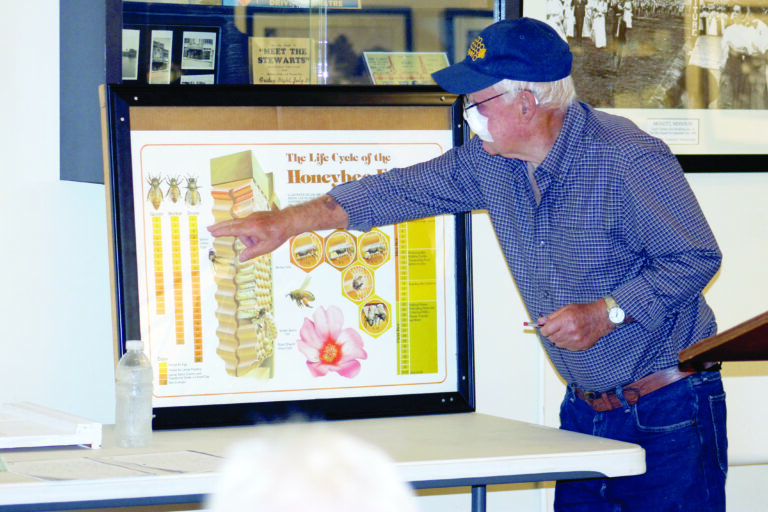
John Schmidt shares lifetime of insight
By Murray Bishoff Special to the Monett Monthly
The mysterious world of honey bees came to life for the Monett Historical Society’s June 16 meeting.
John Schmidt, who has delved into their world as a beekeeper for most of his life, walked those attending the monthly session into their world.
Schmidt, 81, is a past president of the Southern Missouri Beekeepers of Monett, an organization that presently has 77 members.
Schmidt said there is much people don’t know about how bees communicate, yet they share a great deal of information through dance, vibrating their wings, sharing smells and other ways yet unknown. Beekeepers have to know basics about how hives operate to maintain them.
Schmidt noted bees can travel three to eight miles to gather nectar. Flowers bloom at different times, providing a constant source of food, starting with dandelions in the early spring, then sugar maples, Catalpa trees, sweet clover, ending with fall ragweed. Pure honey is white, but gains color from different sources. Late-season honey may be a dark gold, but it has properties that can serve as anti-allergens to people eating it. Schmidt said for the best medicinal results, people should buy honey grown within 25 miles of where they live.
Bees stay active as late as Thanksgiving and must maintain at least 40 pounds of honey in their hive to serve as food through the winter. Beekeepers cannot harvest more than that or the colony will starve.
Much of the activity in the hive focuses on the comfort of the queen bee. The queen is constantly laying eggs. The center of the hive has to stay at 97 degrees in the winter for the larvae to grow. To keep the hive from getting too hot in the summer, Schmidt said workers carry in water from nearby sources and vibrate their wings to spread the moisture like an air conditioning system. In winter, the bees form a circle around the center of the hive, rotating in shifts from the outside back to the warmer center to keep from freezing.
Hives can have 60,000 to 100,000 bees, Schmidt noted. Since each bee only produces a small amount, the hive needs quantity to thrive. Bees carry two ingredients from the field to the hive: nectar, which comes from plants and is regurgitated in the hive, and pollen on their bodies. Those two ingredients are combined in the hive itself to make the honey.
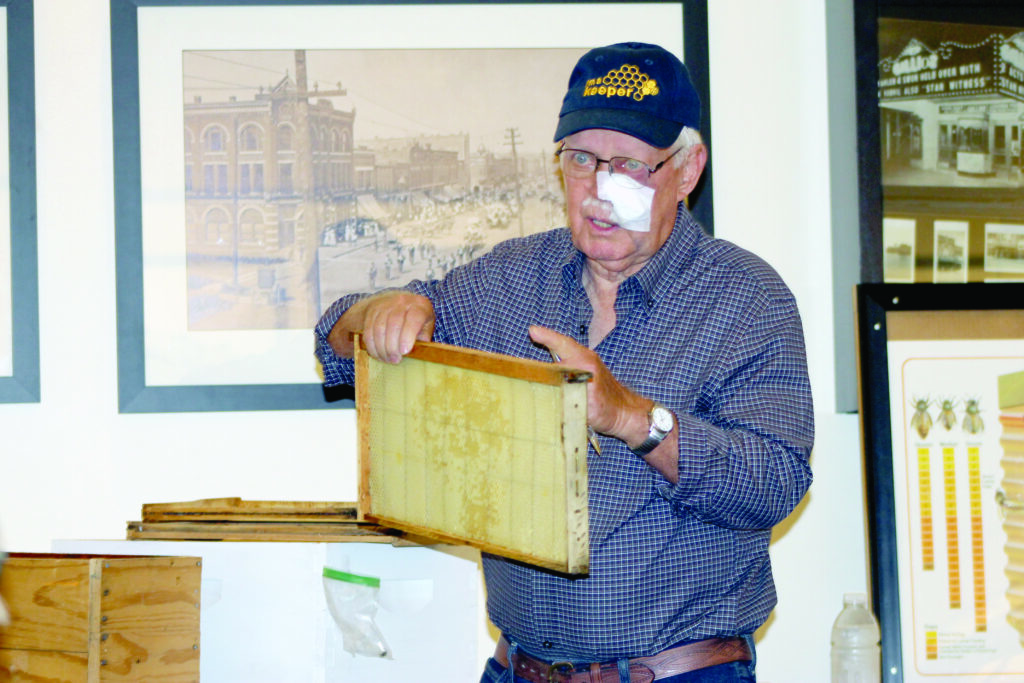
Schmidt brought beekeeping equipment with him. One box he called a deep hive up to 10 trays that serve as a honeycomb, each with 600 imprints on each side that the bees could use, for a total of 1,200 usable spaces for storing honey or laying eggs. In a hive arrangement, bees are inclined to travel up, not down. On top of the deep hive, Schmidt places a half-sized box called the nucleus that serves as a rainy-day supply. On top of that, he places an even smaller box that serves as the honey reserve.
The main enemies of honey bees are mice and mites. Mice chew their way inside a hive to access the honey, but damage everything and poison the operation with their waste secretions. Schmidt showed a wire reducer that beekeepers place outside the hive with openings of an inch or less to keep out mice. Treated sheets can be placed twice a year inside the hive combs with a toxin that will kill the mites. Treating more often would build immunity and prove counterproductive, he added.
Queen bees can live up to four years, Schmidt said, but must be replaced quickly if they become ill or stop functioning.
“It takes 16 days to hatch a queen,” he said. “We don’t know how they know they need to make queen eggs.”
If a virgin queen cannot produce eggs, the workers start to make new queen cells, as many as five at a time. The first queen to hatch will proceed to kill the others to be the only queen. If two queens hatch at once, they may fight to the death, Schmidt added.
Workers hatch in 21 days and make up 95 percent of the hive population. How bees know to maintain that balance is another mystery, Schmidt said. They have a curious life cycle, spending two weeks as foragers, then cleaning out cells, feeding the young and old, and finally dying when they wear out their wings.
Drone bees take 24 days to hatch. Their sole purpose is to inseminate the queen. After August and in hot weather when drones are no longer needed, the workers kill them.
“Beekeeping is not for everyone,” Schmidt said. “Some people are highly allergic [to bee stings].” “For me, a sting is like a mosquito bite. The poison comes out and I can scrape it off on the second day.” More allergic people can have an anaphylaxis reaction where their windpipes will be squeezed shut. Carrying EPI-pens becomes crucial for those folks to administer an antidote.
Schmidt said it’s not unusual to pay $1 an ounce for good local honey. Moisture may leave honey and it becomes crystalized, but warming it will restore its form. Honey found buried with Egyptian mummies, he noted, can be restored to quality. Good honey is no more than 18 percent liquid. Some vendors, especially those who import honey, pass off more watery honey by adding Karo syrup, which can pass by taste but not by a hydrometer measurement, he added.
The next membership meeting of the Monett Historical Society will be at 7 p.m. on July 21 at the museum’s event center. The legends of Monett’s underground caves will be the topic.
Ericka Clark is the current president of the Southern Missouri Beekeepers of Monett and can be reached via email at [email protected] or by phone at 417-678-4065. Their next meeting will be at 6:30 p.m. on July 21 at the First United Methodist Church, 1600 N. Central Ave. in Monett.