Local author’s first book published
Branstetter’s reproductive stories cover sensitive topic
By Sheila Harris [email protected]
Within her busy schedule, Kayla Branstetter, of rural Purdy, found time to write a book.
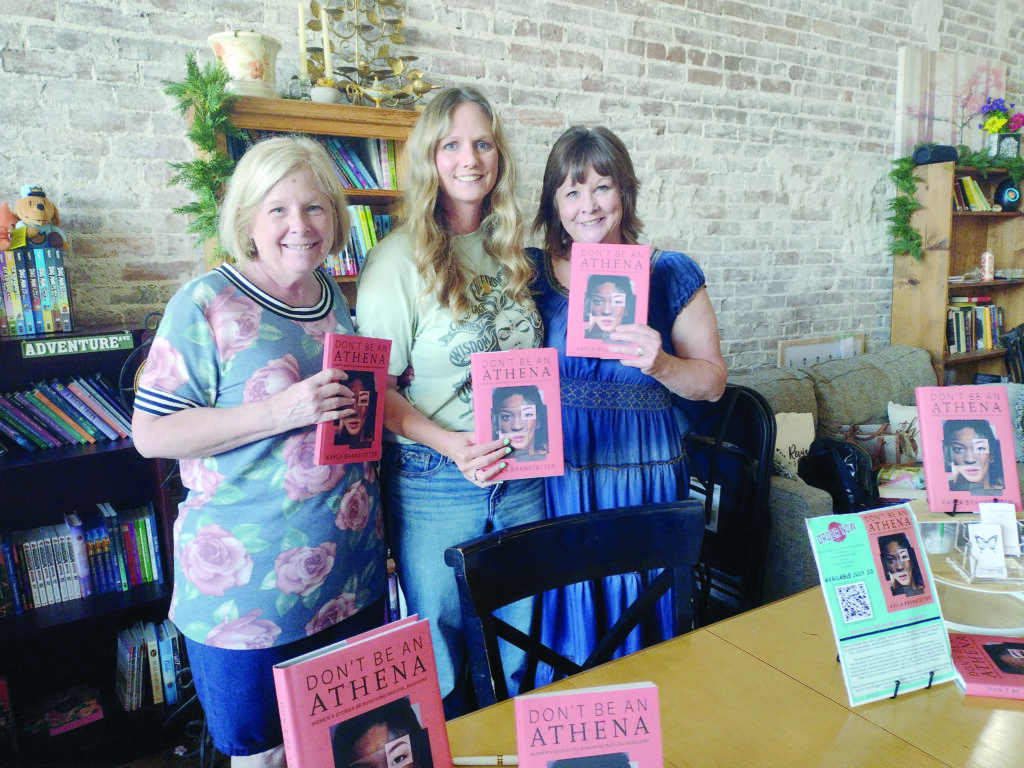
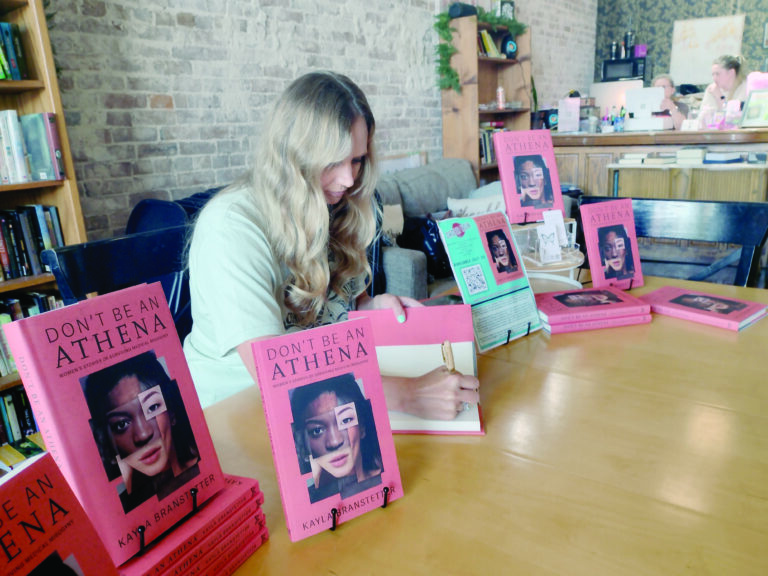
The release of “Don’t Be An Athena” — published by Ozark Hollow Press, and marked by a book-signing at Morgan’s Hollow Bookstore in Monett, on July 20 — represents six years of work, Branstetter said.
As an English instructor at Crowder College, the wife of Wheaton High School coach, Chris Bransetter, and the mother of two young daughters who both play travel ball, Branstetter’s plate already seems pretty full. Now, she will add a book-signing tour to her itinerary.
Although the book took several years to complete, Branstetter said it’s been a lifetime in the making. Its theme centers around the way society as a whole, and women, in particular, make cruel judgment calls about the reproductive choices — or about reproductive issues beyond their control — in the lives of other women.
Branstetter compares the judgers to the goddess Athena, who, out of jealousy, cast a vicious curse on her beautiful servant, Medusa, condemning her to a life of shame, after she was violated by the god Poseidon.
“My unwed parents got pregnant with me, when my mom was 16,” Branstetter said. “In the 1980s, in southwest Missouri, tradition dictated that they get married to keep me from being born ‘out of wedlock.’”
Branstetter said that although she was the product of her parents’ choice, she felt as though she, herself, bore a part of the community’s condemnation of their decision.
“It is an unforgiving certainty that the children of teenage mothers are more likely to become teenage parents themselves,” Branstetter said.
In school, Branstetter said, some educators treated her like a future high school dropout, one who would “get knocked up.”
Determined to break the cycle of a wheel set in motion during previous generations, Branstetter became hyper-vigilant in her attempt to avoid becoming a statistic of teenage-motherhood, herself.
“Little did I know that when I did get married, and we started planning a family, that I would struggle with unexplained infertility,” she said.
That irony is not lost on Branstetter.
“When we finally did get pregnant, I just about lost our oldest daughter, Berlin; then, I did have a miscarriage with our second pregnancy,” Branstetter said.
The couple’s third pregnancy resulted in the birth of their second daughter, Leigha, after a full-term pregnancy without complications.
Branstetter said infertility is a lonely place to be, especially when you see women around you — your friends and family members — becoming pregnant with ease.
“A failure to conceive can feel like a personal failure in your role as a woman,” Branstetter said. “And, when a long-awaited pregnancy ends in miscarriage, it can be doubly devastating.”
Branstetter said that women sometimes don’t know how to show compassion to each other in these types of reproductive heartbreaks, as well as others — in part, because they can’t fully empathize.
Branstetter’s hope is that her book, “Don’t Be An Athena,” will shine light into those areas of women’s lives where other women may have historically cast judgment, or have been unaware of how to empathize.
“Women can be each other’s worst enemies,” Branstetter said. “We need to start changing that narrative.”
“Narrative Medicine,” as Branstetter labels the new genre of instruction she hopes to incorporate into Crowder College’s curriculum, will focus on learning, relating, conveying and, above all, empathizing with the personal stories of the patients with whom medical personnel interact.
“Don’t Be An Athena,” Branstetter admits, can be a tough read. Many of the chapters contain content-warning labels, not because they’re sexually detailed, but because they can trigger bad memories from the past, for the women who read them. However, within those memories — resurrected by women who traveled a similar path and came out on top — may lie a path forward for women trying to heal from past traumas.
The book is a compilation of the true narratives of the reproductive lives of women from various eras and different walks of life who Branstetter interviewed over the last several years.
Included at the end of “Don’t Be An Athena” is a section of helpful resources: tools for “Advocacy, Survival, and Voice,” as Branstetter calls them. They cut a broad swathe, and include such topics as crisis and domestic violence resources, education and youth development, mental health trauma, reproductive healthcare, community support, fertility and pregnancy loss, support for loved ones, patients’ rights, and writing for healing.
With “Don’t Be An Athena” now available for purchase, Branstetter will begin a book-signing tour. Some scheduled stops include Oklahoma City; Boston; and Key West, Fla.
This fall, Branstetter will be heading “down under,” to speak about her narrative medicine research, as well as her book, at an international conference at the University of Sydney, in Sydney, Australia.
“Don’t Be An Athena” can be purchased online from Ozarkhollowpress.com, Amazon, Walmart or Barnes & Noble.