
Barry County teams up with ICE
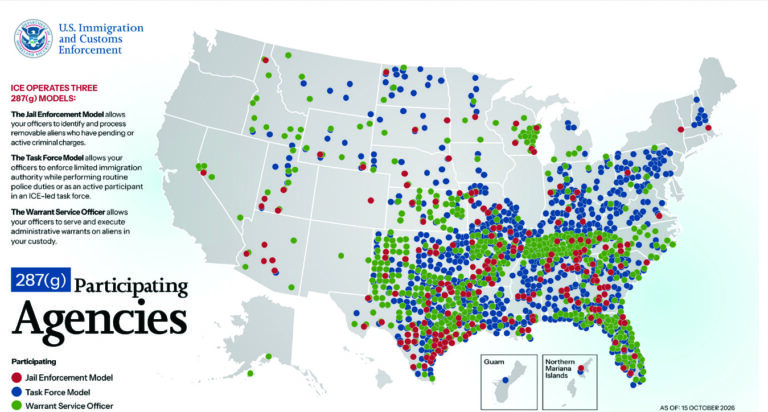
Sheriff’s Office joins adjacent counties in Task Force Model agreements
By Sheila Harris [email protected]
On Sept. 16, the Barry County Sheriff’s Office signed an agreement to partner with Immigration and Customs Enforcement (ICE).
The Task Force Model (TFM) 287(g) agreement will allow local officers to assist ICE with immigration arrests and detentions in Barry County.
The ICE website states that local law enforcement officers “will get access to ICE resources and training.” After completing a 40-hour, online training course, the TFM agreement will give Barry County deputies broad discretion for immigration enforcement.
According to 287g.recoveredfactory.net (a Muck Rack journalism project that tracks law enforcement agreements with ICE across the nation), TFMs allow officers to make first contact, and [to] arrest based solely on suspected immigration status.”
“Officers can question anyone about immigration status during any encounter; access Department of Homeland Security Databases; make civil immigration arrests (no state criminal charge required); issue detainers; and initiate removal proceedings,” Recovered Factory states.
TFMs are distinct from two other forms of ICE agreements: Warrant Service Officers (WSOs) and Jail Enforcement Models (JEMs), which typically apply only to jail settings.
The Barry County Sheriff’s Office joins the sheriffs’ departments of neighboring counties — Stone, Lawrence and Newton — who also have Task Force Model 287(g) agreements with ICE in place, as do Jasper, Christian and Greene Counties.
As of October 21, a TFM had not been reported for the McDonald County Sheriff’s Department. However, municipalities within that county do have TFMs.
In Barry County, in addition to the sheriff’s department, the cities of Washburn, Wheaton and Seligman have TFM agreements with ICE.
Seligman Police Chief Matthew Phillips said Seligman entered into an agreement earlier this year.
“Maybe February or March,” he said.
Phillips said the city receives a stipend from the federal government for partnering with ICE, although he did not disclose the amount.
“It depends on how much enforcement we do,” Phillips said. “We have four officers – two who work with ICE.”
According to the ICE website, in exchange for arresting and holding prisoners for ICE, counties and municipalities are eligible for reimbursement through the federal government’s State Criminal Alien Assistance Program (SCAAP).
“SCAAP provides federal payments to states and localities that incurred correctional officer salary costs for incarcerating undocumented criminal aliens,” states the linked website of the Bureau of Justice Assistance’s (BJA), the agency responsible for administering the SCAAP program.
According to BJA, an “undocumented criminal alien” is described as one who has been convicted of at least one felony or two misdemeanor violations of state or local law.
In order to qualify for reimbursement from the SCAAP program, prisoners must be incarcerated for at least four consecutive days during a reporting period, and must have been apprehended and convicted in an applicant’s own jurisdiction.
Of Missouri’s 114 counties, Barry County is one of 61 counties in Missouri that have TFM agreements with ICE. Statewide, as of Oct. 21, Missouri had 144 TFMs in place, which include both county and municipal law enforcement agencies, Recovery Factory reported. Most of the cooperating law enforcement agencies are located across the Missouri Ozarks.
The majority of Task Force Model agreements were signed during the past year.
Barry County’s September agreement with ICE precedes the Nov. 3 vote on Amendment 8, which seeks to constitutionalize the role of locally-elected county sheriff.
A clause in the ballot language of Amendment 8 states that Missouri’s attorney general will be the only person with the authority to remove a sheriff from office.
According to current Missouri law, a sheriff is subject to removal by impeachment if he fails to perform his duties.
Amendment sponsor, Senator Jill Carter (R-Granby), says the additional clause in Amendment 8 will “remove [the sheriff] from the pressure of local political influence.”
“We want the sheriff to be able to do his job without being distracted by local politics,” Carter said.
In McDonald County, local influence led to the suspension of the City of Noel’s recently-appointed marshal, Daniel Vaughn, and the dissolution of Noel’s TFM agreement with ICE.
The decision on both measures was unanimously made by Noel City Council after an October 13 meeting, where hundreds of residents showed up to protest the recent arrest and detention of 19-year-old McDonald County High School student, Rodrigo Gonzalez Carbajol, following a high school soccer game against Cassville. Carbajol’s immigration case is now in federal court.
In addition to protesting Carbajol’s arrest and detention after a routine traffic stop for speeding, McDonald County residents had a broader concern about whether Noel’s participation in the 287(g) program had been properly authorized.
According to Newstalk KZRG, Brian Bogart, retired police lieutenant, “questioned whether Marshal Vaughn had obtained proper authorization from the council, and whether established procedures were followed during Gonzalez Carbajol’s detention.”
“I understand that [287(g)] is a federal program, but federal participation does not eliminate the need for proper local authorization, accountability, or compliance with the law,” Bogart told the [Noel] council.
Barry County sheriff, Danny Boyd, was unavailable for comment before presstime.