Petroleum leaks investigated
Leak detected at Monett gas station; Cassville Hilltop case revisited
By Sheila Harris [email protected]
Missouri currently has no laws which require property owners and landlords to disclose the presence of hazardous waste sites on nearby properties to prospective buyers and tenants – even though waste from those sites often has the potential for migrating through soil and groundwater, sometimes miles beyond the source of contamination.
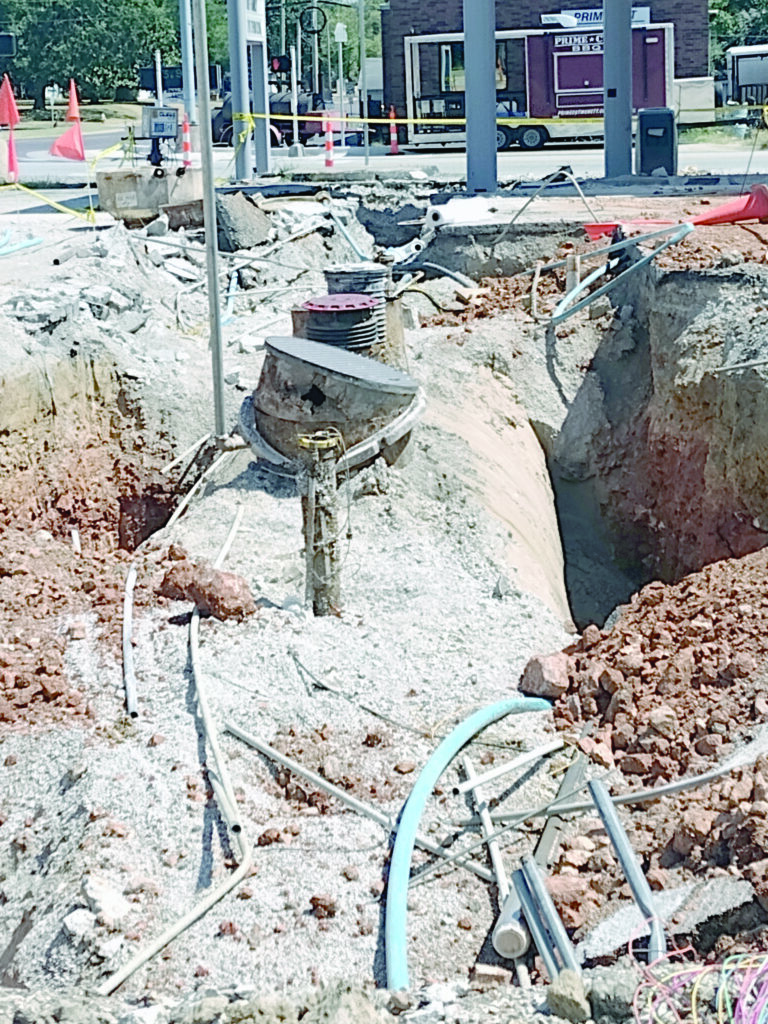
Underground fuel storage tanks (USTs) buried before 1988, the year more stringent tank regulations were implemented by the Missouri Department of Natural Resources (DNR), are one source of potential contamination.
Prior to 1988, if a gas station or other business with underground fuel or solvent tanks closed, their tanks could be sealed and left where they were, contents and all, Ken Koon, former director of the Tanks Section of the DNR, told the Cassville Democrat in a 2024 interview.
“No inspection of the site was required, nor were samples of soil and the tanks’ contents taken and recorded,” Koon said.
The old tanks, Koon said, are subject to corrosion, and exist in unknown condition, without oversight and not subject to current regulations (https://tinyurl.com/3p7vypdz).
According to industry sources, the average lifespan of the USTs typically used before 1988 is 30 years. Many now lie buried on private property, where new property owners have no interest in uncovering liabilities they may have to take responsibility for.
Often, the only way to know that something is amiss with an old UST is when fuel surfaces or show’s up in someone’s well.
“Then, we might be able to get a search warrant to allow us to look for the problem,” Koon said, in 2024.
Some of the pre-1988 tanks are still being used commercially.
The DNR is currently overseeing an active investigation in Monett.
In Cassville, a case involving a petroleum leak that caused contamination in wells in the Hilltop area, south of town, during the late 1980s and early 1990s, remains on “Active” status with the DNR.
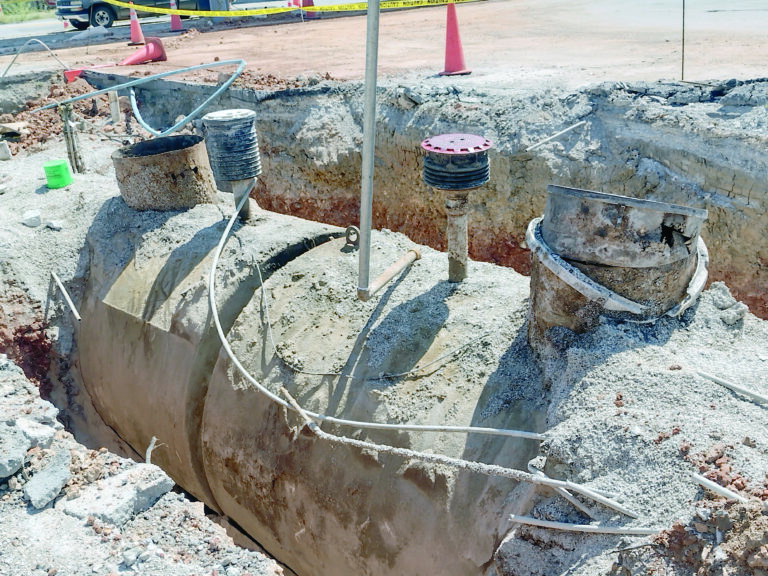
In Monett, Bobbi Koepke, with Environmental Works in Springfield, called the DNR’s Environmental Emergency Response (EER) Spill Line on June 17, after fuel was discovered coming up in cracks at the edges of the parking lot at Rapid Roberts, at 914 Central.
According to the EER’s Incident Report, the “approximate 50-gallon release” was due to an “equipment malfunction/failure.”
Steve Makoski, Director of Compliance for Rapid Roberts’ corporate headquarters in Springfield, said the two, 10,000-gallon fuel tanks at the convenience store had been in the ground since the mid-1980s.
After excavation around the pumps and tanks, Makoski said that the tanks themselves didn’t appear to be leaking.
“With the cathodic protection we use, tanks can last as long as 40-50 years,” Makoski said.
Cathodic protection (CP) typically involves energizing ions to create a protective shield for steel tanks.
“A [distribution] line to one of our pumps appeared to be the source of the fuel release,” Makoski said.
Before excavation work began, Rapid Robert’s contractor, Environmental Works, alerted neighbors to the fuel release, and drilled monitoring wells to determine whether gasoline had impacted the groundwater.
“There is contamination in the ground,” said Angela Oravetz, Environmental Program Manager for the DNR’s Environmental Remediation Program.
“Water sampling is occurring at the facility as well as at surrounding properties,” Oravetz said.
In a separate email, Kristen Doran, Drinking Water Section Chief, with DNR’s Southwest Regional Office, stated that her department collected two special samples near the fuel release on Aug. 4, to determine if product had entered into the main waterline of Monett’s distribution system.
“Both of these samples were non-detect for petroleum products,” Doran stated.
Doran indicated that additional water sampling will be conducted.
According to the Environmental Protection Agency (EPA), the Volatile Organic Compounds (VOCs) commonly found in petroleum fuels and solvents include a variety of chemicals: some man-made, and “some which may have short and long-term adverse health effects.”
In southwest Missouri’s fractured karst bedrock, VOCs and other contaminants can enter groundwater and migrate rapidly.
Petroleum in groundwater and soil can allow potentially harmful vapors to rise into businesses and homes through pathways created by building foundations and sewer lines.
Skip Schaller, Monett city utilities superintendent, said he believes gasoline had been leaking at the Rapid Roberts’ site for an undetermined amount of time.
“It appears that some of it [has] migrated off the property,” he stated.
Schaller said there’s still “more work to do to determine the extent [of migration],” and that Environmental Works is waiting to receive proper work-zone signage before beginning sampling below Central Avenue.
The Tank Section of the DNR will be overseeing the remediation process.
Makoski said Rapid Roberts plans to replace their old fuel storage tanks with newer, upgraded tanks, when they replace the fuel distribution lines.
Eric Hoyle, DNR Environmental Program Specialist, said the department is currently awaiting “the completion of release investigation and underground storage tank closure activities,” which could begin the week of Sept. 14.
After the completion of the initial investigation and the closure of the old tanks are complete, Hoyle said Rapid Roberts will be required to conduct additional site investigations regarding the extent of the release and any unacceptable risks associated with the remaining contamination.
In Cassville, Hoyle said that an investigation at and near the property of the L & L Convenience Store at Hilltop, south of Cassville, is still considered open and active, even though remediation at the site was abandoned in 2009.
According to a Jan. 4, 1989, article in The Cassville Democrat, in 1988, traces of petroleum were found in the private well of Mr. and Mrs. Harold Miller, residents of the Hilltop area. The discovery prompted further investigations.
A March 11, 1992, article in the Cassville Democrat reports that Hilltop resident, Dennis Hurst, petitioned the Cassville city council to allow him to temporarily hook into the city’s water main because his well — which served six duplexes and a residence — was contaminated.
The City granted him permission.
Over 30 years later, Hoyle said that the Hilltop investigation is still considered open and active, because neither the extent of off-property migration, nor the source of the petroleum that showed up in neighborhood wells had ever been pinpointed.
A DNR summary of the Hilltop site reports that it was “the location of a plume of volatile organic compounds in groundwater.”
“In June 1991, the groundwater well serving both the SOS Convenience Store and a restaurant was found to be contaminated with volatile organic compounds,” the report states.
The investigation at the site was conducted by the DNR Superfund Section in 1992.
“Analysis of samples from the SOS Convenience Store well from 1991 through 1993 indicated the presence of various gasoline-related constituents, including benzene, toluene, ethylbenzene, xylene, and methyl-tertiary-butyl ether (MTBE), as well as 1,2-dichloroethane,” the DNR summary states. “The plume was suspected to have originated from leaking underground storage tanks at one or more nearby gasoline stations with regulated underground storage tanks.”
According to the report, “No cleanup activity occurred at the site under Superfund oversight.”
The site was referred to the department’s Tanks Section for follow up in October 1993 (https://tinyurl.com/bdf3dcc9).
Hoyle said it appears that any remediation that may have occurred at the L&L Convenience Store at Hilltop was abandoned on Jan. 27, 2009.
“The responsible party [for the fuel release] was determined to be unable to financially complete remediation activities, [and] it appears the current owners of the property, who are not responsible for this release, have not expressed an intention to continue those activities,” Hoyle said. “The last report documenting contaminated soil and/or groundwater [at the site] received by the department was a Source Investigation dated May 2, 2001.”
Hoyle said it doesn’t appear that enough information has been submitted to the department to determine the impacts of migration off of the property.
“The source of the contamination is still unknown at this time,” Hoyle said. “The department is aware of two currently active underground storage tanks and two former underground storage tanks [at the Hilltop site]. Two 10,000-gallon tanks, storing regular unleaded gasoline and diesel fuel, respectively, remain in use; one 4,000-gallon tank has been closed in place; and one 4,000-gallon tank was removed in 2013.”
Richard Asbill, Cassville city administrator, said city water serves L&L Convenience Store and Sportsman’s Corner, on the west side of Highway 112, at Hilltop.
According to the Environmental Protection Agency, over 581,000 releases from underground storage tanks have been confirmed across the US, as of September 2025.
Nearly 528,000 contaminated sites have been cleaned up, the agency said, but about 54,000 sites remained to be cleaned up, at that time.
Many other tanks remain underground in unknown condition, Koon said.
Although in Missouri there are no laws requiring property owners and landlords to disclose the presence of neighboring USTs and hazardous waste sites, buyers and renters can conduct their own due diligence.
The DNR’s website features an environmental site-tracking tool at https://tinyurl.com/2s4ehpt2. The tool discloses the sites of current and past hazardous waste investigations, as well as reported underground storage tanks – both those currently in use, and tanks which were closed in place prior to current regulations.
The EPA maintains a similar mapping tool to track Superfund sites at https://tinyurl.com/msbcph3d.
Residents who suspect that petroleum is impacting soil or water on their property may contact the DNR’s Southwest Regional Office at 417-891-4300.