Revolutionary War descendant’s grave marked near Butterfield
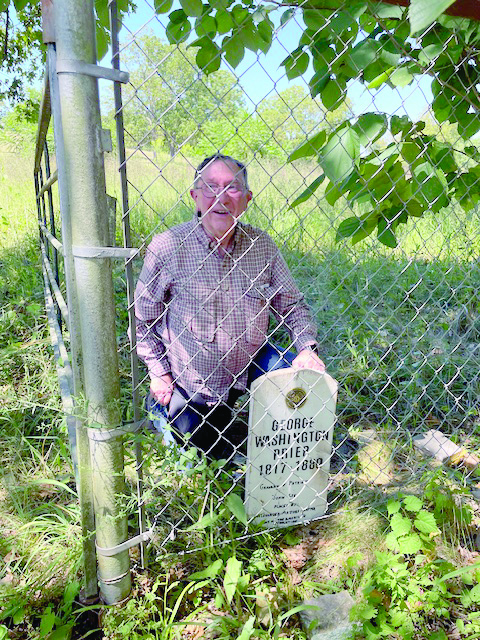
Man rode bike by cemetery as child unaware great-grandfather was buried there
By Kyle Troutman [email protected]
A family name that puzzled Dan Prier for much of his life finally has an answer — one that reaches back to the Revolutionary War and a soldier who served under Gen. George Washington at Valley Forge.
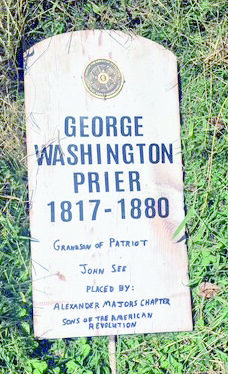
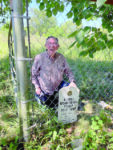
Prier, who grew up in the Butterfield area, recently placed a memorial marker at Bullington Cemetery, northeast of Butterfield, honoring his great-grandfather, George Washington Prier, a grandson of Revolutionary War patriot John See.
The marker, placed outside the cemetery gate during the summer, is part of an America 250 initiative by the Sons of the American Revolution (SAR) to recognize not only Revolutionary War patriots, but also their children and grandchildren who helped carry their families’ legacies westward.
For Prier, who now lives in Raytown, the project connected several generations of family history and answered a question he had carried since childhood.
“I grew up in that area, and my dad ran the East Purdy Store from 1948 to 1960,” Prier said. “I always wondered why Washington was his middle name, John Washington Prier. I thought, ‘There’s no Washington in our family that I know of.’”
The answer emerged through genealogical research conducted by his cousin, Carol Swanson, who joined the Daughters of the American Revolution (DAR) and traced their family lineage to See.
Prier used her research to support his own application to join the Sons of the American Revolution.
As the family learned more about See’s military service, Prier discovered that the patriot had served three years in the Revolutionary Army, including time under Washington’s command and the winter at Valley Forge.
See’s daughter, Polly, married Wesley Prier in Virginia. Their first child was named George Washington Prier, apparently in honor of the stories Polly had heard about her father’s service and admiration for Washington.
That George eventually moved from Virginia to Indiana and Iowa before settling in southwest Missouri. Among his children was Prier’s grandfather, Joseph T. Prier.
George Washington Prier’s name also carried into the next generation, when Prier’s father was named John Washington Prier.
“Basically, my great-grandfather’s grandfather was a patriot,” Prier said. “Finally, I get back to here’s the story of why this guy was so important and even important in American history, because his grandfather was an American patriot, and I had no clue about that.”
The connection also helped Prier understand the family’s roots in Barry County. His great-grandfather George was the first Prier in the family line to settle in the area, arriving from Iowa in the late 1800s. His descendants spread throughout the county, creating a large network of cousins.
Prier said he recognized many of those family connections from growing up in the area, including classmates who were descendants of Prier relatives.
“It was kind of neat to get that connection that he was the source of all the Priers that were in the area,” he said.
The SAR traditionally marks the graves of Revolutionary War patriots. For the nation’s 250th anniversary, the organization expanded the effort to include descendants of those patriots, recognizing the role their children and grandchildren played in settling communities across the country.
According to the SAR’s America 250 program, the effort is intended to connect the history of the nation’s founding generation with the descendants who helped establish communities and states as the country expanded west.
The program seeks to place grave markers on the burial sites of sons, grandsons, daughters and granddaughters of Revolutionary War patriots.
Prier learned that his great-grandfather was buried at Bullington Cemetery, and he had passed the cemetery many times as a child without realizing what it was.
“One of my best friends from school was like a half a mile down the road, and I’d ride past that cemetery on my bike,” Prier said. “I never even knew it was a cemetery because it was overgrown and it wasn’t identified as a cemetery plainly enough that I even knew that.”
The cemetery has not been used for new burials in more than 100 years, and Prier said there are no grave markers for his great-grandparents. Rather than place the medallion where a specific grave could not be identified, he installed it just inside the cemetery gate.
Prier said the experience was especially meaningful because it connected him to the many relatives who remained in the area. Hestill has family in Barry County, including cousins in Eagle Rock and other relatives scattered throughout the region. His half brother, Winfred, who will turn 90 on Nov. 13 and operated the Ball and Prier store and tire company in Golden, was unable to attend the marker placement because of a board meeting with Carroll Electric Cooperative in Arkansas.
Prier said the family has also had other members serve in the military, including his brother’s years in the National Guard and his brother-in-law’s service in the Pacific during World War II.
He recalled that his own draft lottery number during the Vietnam War was 253. At the time, Barry County never called more than the first 50 numbers, so he was not drafted.
“I would have served if I had to, but I didn’t need to because they weren’t going to call my number anyway,” he said.
Prier said he takes pride in relatives who served and remembers friends who made the ultimate sacrifice.
“I’m very proud of the fact that the families that did have members serve,” he said. “I’ve always been very blessed to know that they were good people and that they went willingly to serve and to, in this case, die.”
The marker project has also encouraged Prier to learn more about the lives of his ancestors, including stories passed down about See’s childhood.
According to family history shared by Prier, See was about 4 or 5 years old when his family’s farm in western Virginia was attacked by Native Americans. His father was killed, and See and his mother were taken by the Indigenous group. He reportedly lived with the group until his teenage years, was later rescued by an uncle, then eventually returned to live with the Native Americans before entering the Revolutionary Army as an adult.
Prier also shared a family story that See learned methods of using boiled tree bark from the people with whom he lived. The story says he used that knowledge to create a substance that soldiers could apply to their feet to help keep them warm during the winter at Valley Forge, when many lacked adequate footwear.
Prier said he has not been able to verify that account, but it is part of the family history he has heard.
For those interested in their family histories and possible patriots in their lineage, Prier said genealogical research can be pursued through services such as Ancestry.com, although subscriptions may be required. His cousin Carol completed much of the research supporting his SAR application and has identified seven or eight other Revolutionary War patriots in different branches of their family.
Prier said he would be willing to contribute toward a permanent headstone for his great-grandfather if the cemetery could be cleaned up. For now, the medallion at the cemetery gate provides a visible connection to a family story that had remained largely unknown to him.
“It’s just tracing back and finding the nuances of the way people live and the things that they did with their lives,” Prier said. “I have been really kind of honored and impressed by some of the things that I found about the family and particularly about that patriot.”