Residents voice concerns about Cassville storage tank
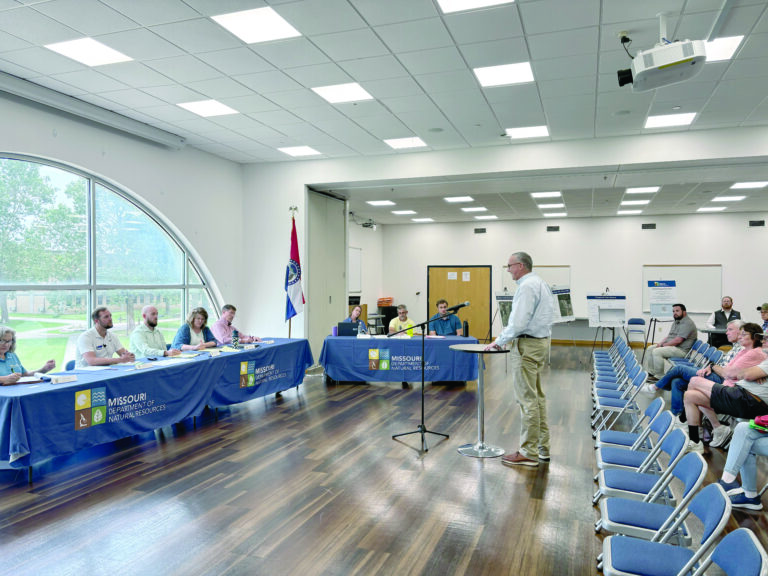
Mayor, city admin speak at DNR meeting in Neosho
By Sheila Harris [email protected]
About 30 people attended a public meeting at Crowder College in Neosho, hosted by the Missouri Department of Natural Resources (DNR), on Thursday.
The in-person meeting was one of two meetings scheduled by the DNR in response to area residents’ concerns about the proposed construction of three storage tanks designed to hold food and meat-processing residuals (commonly called “sludge”) until they can be land-applied to area farms. A follow-up, virtual meeting was held on Monday.
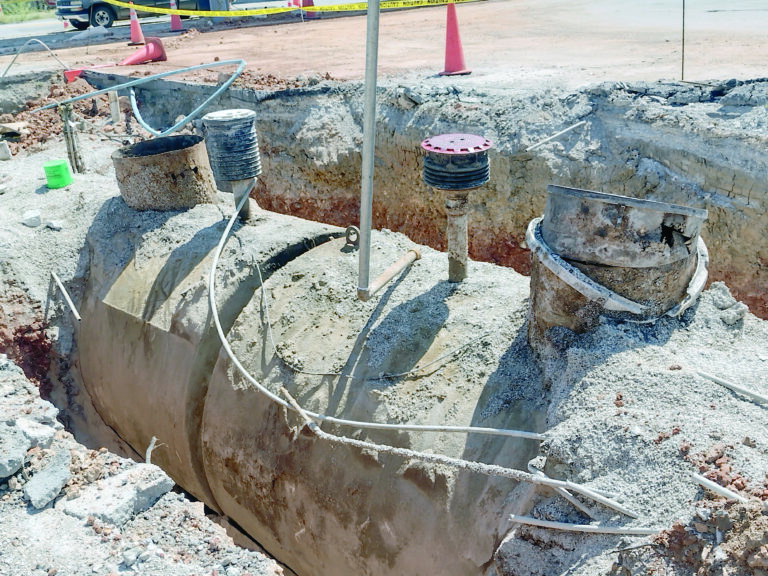
HydroAg Environmental, LLC, proposes to build a sludge storage tank two miles north of Cassville, east of Farm Road 1095, on property owned by Mike Henbest. Denali Water Solutions has also applied for a permit to construct a sludge storage tank near Wentworth and another near Humansville.
All three sludge tanks will have a storage capacity of over 900,000 gallons, with 12 inches of freeboard space required between the surface of the sludge and the top of the tank. Weekly checks of liquid levels in the tanks will be required to ensure 12 inches of freeboard above them.
Permit applications for Denali’s and HydroAg’s proposed storage tanks were signed by the same representative, and use the same post office box in Russellville, Ark., as their business address.
In their announcement of the public meeting, the DNR requested that comments be limited to concerns about the proposed storage tanks, but many residents viewed it as an opportunity to have their say regarding the entire land-application practice.
Of the more than 10 residents who spoke, most cited concerns about the smell of the land-applied sludge, which, they say, is unlike the smells associated with traditional farming practices.
Jon Horner and Richard Asbill, mayor and city administrator for the city of Cassville, respectively, were among those in attendance at the public meeting.
“It’s not just the storage tanks and their contents that I’m worried about,” Horner said. “The tanks are being built for a purpose, and that purpose will include land-applying sludge to fields around here.
“Denali already has a bad track record. We’ve had two major spills in Barry County, alone, and we don’t yet know what the long-term impact of those spills will be.”
Almost three years ago, a sludge tanker overturned and spilled its load along Missouri Highway 76, east of Cassville, near Lohmer Tower. In December 2022, another tanker split open and spilled its contents on private property on Washburn Prairie, a sensitive area within Roaring River Spring’s 47-square-mile recharge area.
“Cassville is called the ‘City of Seven Valleys’ for a good reason,’” Horner said. “Those valleys funnel water into Flat Creek and Roaring River Spring. We don’t want the odor of land-applied sludge impacting visitors to Cassville and Roaring River State Park. Nor do we want it impacting the spring water itself.”
More than one million people visit Roaring River State Park every year, which ranks in the top five most-visited of Missouri’s 93 state parks and historic sites.
Horner also expressed concern about the long-term impact of sludge-application on property values.
“We’ve been hearing from citizens and business owners who fear what will become of our town if it starts smelling like sludge,” Horner said. “Cassville takes great pride in being called ‘America’s Real Hometown – the Home of Roaring River State Park.’ We don’t want the stigma associated with sludge to harm our well-earned image.”
As the city administrator of Cassville, Asbill is familiar with the operation of the city’s wastewater treatment facility, which he compared to that of Cassville wastewater-residual sludge storage tank, planned for a site just a mile or so north of a known cave system: Crystal Caverns.
“We have someone monitoring Cassville’s wastewater system around the clock – 24/7,” Asbill said. “But, that isn’t in the plans for this proposed wastewater storage tank. It could be hours or days before anybody became aware of a problem if one developed.”
The DNR’s draft permit for the storage tanks includes the requirement for a 24/7 leak-detection system that will sound an alert if there’s a leak from the storage tank, but there is no requirement for an around-the-clock physical presence. Leak detection equipment must be checked monthly, to ensure that it’s in working order.
Any unauthorized leaks or discharges must be reported to the DNR as soon as possible within 24 hours, the draft permit states.
Horner questioned why the DNR proposes to permit the land-application of sludge at all in Missouri.
“Why are they letting Arkansas businesses bring Arkansas’ and other states’ waste into Missouri to use us for a dumping ground?” Horner asked.
The question has yet to be answered.
Cassville resident Don Craig isn’t optimistic that Thursday’s DNR meeting accomplished much.
“The meeting was a formality; just a box they had to check,” he said.
Heather Peters, chief of the Water Pollution Section of the DNR, stated that her department will move forward with perfecting the language of land-application permits for food and meat-processing residuals after the storage tank permits are approved.
The draft permit for the Cassville storage tank can be found at https://tinyurl.com/55asbm7r.