Alarm in the name of karst
Cassville native advocates for clean water
By Sheila Harris [email protected]
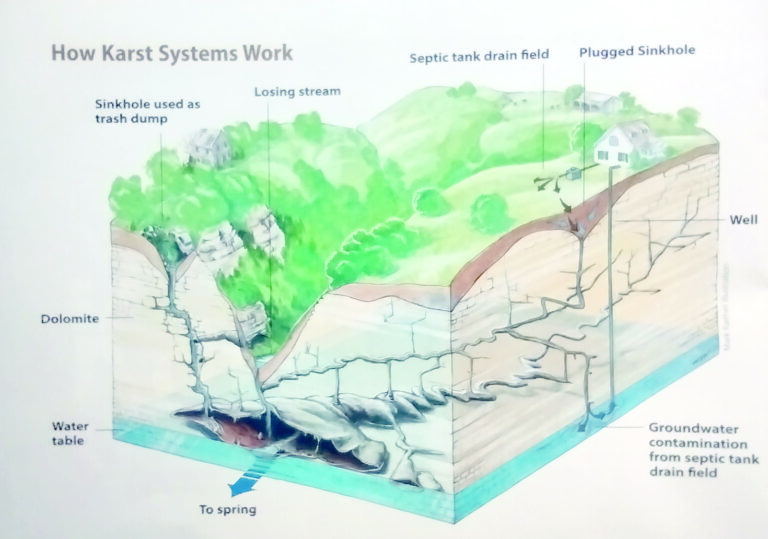
Karst topography represents a source of endless fascination for explorers, but its quirky characteristics — consisting of ever-dissolving limestone and dolomite, fractured with fissures, sinkholes, caves, springs and losing streams — present unique challenges for Missouri and Arkansas legislators.
Nowhere are the challenges more apparent than along the 300-mile stretch of karst that lies below and on each side of the Missouri/Arkansas state line, between Noel in southwest Missouri and a point east of the Current River. State legislators on each side of that arbitrary boundary have different ideas about what the law should allow when it comes to protecting the groundwater in the fragile karst hydrogeology.
Groundwater travel rates in karst areas are often in the range of a mile per day, while travel rates in non-karst areas are commonly only a few feet per year, according to Tom Aley, Missouri hydrologist in an article published by the Missouri Department of Conservation publication, titled Conserving Missouri’s Caves and Karst.
Ben Miller, Cave Research Foundation volunteer, calls karst a “vast underground plumbing system.” Last year, Miller and fellow volunteer, Bob Lerch, completed a five-year dye-tracing study to determine the extent of Roaring River Spring’s recharge basin.
“The spring’s recharge area covers 47.3 square miles, and extends northwest, past Exeter, to the headwaters of Shoal Creek,” Miller said.
Differences between Missouri and Arkansas state law regarding the karst bedrock that lies below both southern Missouri and northern Arkansas became apparent several years ago, after Arkansas mandated the closure of C&H Hog Farms: a 6,000-head operation that stored and spread liquid feces and urine in the karst recharge area of the Buffalo National River, located some six miles away.
Environmental groups raised an alarm, suspecting the hog farm was contaminating the river with an excess of phosphorus from the manure.
As a result of environmental efforts and public outcry, C&H Hog Farms was closed and bought out by the State of Arkansas. The owners were instructed to empty the farm’s two storage lagoons and dispose of some 1.8 million gallons of liquid manure “somewhere outside of the Buffalo National River’s recharge area,” according to a 2020 article in the Springfield News-Leader.
Waste-hauler, Denali Water Solutions, LLC, hauled the manure some 70 miles due north, where they spread it on farmland, just across the state line, in Taney County, Missouri (https://tinyurl.com/yjdk5auk).
The State of Arkansas has since permanently banned large-scale swine farms from operating within the Buffalo National River watershed (https://tinyurl.com/36vbhvwx and https://tinyurl.com/3w2w94cp).
In another Arkansas-focused lawsuit — one that dragged on for over 20 years — last summer, a federal judge found that poultry conglomerates operating atop karst bedrock in northwest Arkansas violated Oklahoma statutes prohibiting pollution of Oklahoma’s air, land and waters. Their ongoing pollution of the Illinois River Watershed (which conjoins Arkansas and Oklahoma) constituted irreparable harm, the judge said.
A few of the multiple defendants, including Tyson’s, Cargill and George’s, agreed to settle out of court and clean up the watershed, including the Illinois River and Tenkiller Lake, in Oklahoma, which were polluted with excess phosphorus, allegedly from the northwest Arkansas poultry operations (https://tinyurl.com/yzjj4xbv).
The defendants were instructed to remove waste from northwest Arkansas and the Illinois River Watershed to a location where the soil did not already contain excess phosphorus.
Around 2018, Denali Water Solutions constructed two earthen storage lagoons in southwest Missouri, each with a capacity of 15-million-gallons, and began hauling tanker-loads of sludge from Arkansas, into Missouri, where laws and regulations for the storage and land-application of sludge were lax to non-existent.
Missouri legislation changed in 2024, and new permits — including the permit for the Cassville storage tank, as well as one near Humansville and Wentworth — are currently being drafted by the DNR.
Legislative changes in Missouri, however, can’t change the nature of the karst bedrock below Barry County, said Adryana Quinlan, Cassville resident. The 2021 Cassville High School graduate is making it her business to advocate for the preservation of the groundwater quality in Barry County — Roaring River Spring’s, in particular.
“I grew up in a home near Roaring River State Park,” Quinlan said. “Our geology in Barry County has always fascinated me.”
Quinlan knows firsthand about sludge from a lesson learned after graduating from high school.
“When I came home one day, after being away for a while, I ran a big glass of well-water from the kitchen faucet, and started to drink it down, when my mom yelled, ‘Stop! There’s something wrong with our water!’
“That’s when I learned that someone was land-applying sludge in the field across from our house, and that our well-water was a little off. I even questioned whether I should shower in it. When I learned that the land-application of more sludge is planned for our area, I’ve been making it a point to learn as much as I can about our karst hydrogeology, including how easily water can be polluted. If food and meat-processing residuals are allowed to be stored and land-applied on top of our karst, it will be catastrophic for Roaring River Spring and Barry County as a whole.”
Quinlan expressed the same sentiments during a virtual public hearing hosted by the Missouri Department of Natural Resources (DNR) on June 29, regarding the pending issuance of a permit to HydroAg Environmental, for the construction of a sludge-storage tank two miles north of Cassville.
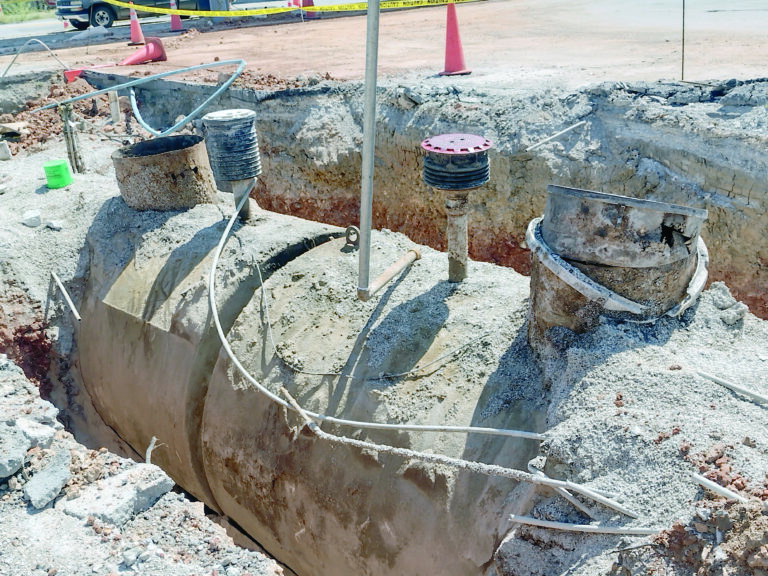
According to the DNR’s draft permit, the Cassville storage tank will contain food and meat processing residuals (poultry, beef and pork, if an application that HydroAg submitted to the DNR in 2024 is an indication), as well as residuals from food-generation, animal-food manufacturing and other organic byproducts.
Chemicals and contaminants not covered in the draft permit will not be allowed, states the current DNR draft, but the department makes exceptions for “incidental amounts of cleaning materials that may remain” after the cleaning materials are used.
Quinlan’s public comments, for the DNR’s official record, were multiple. Her emphasis was whether the DNR had given sufficient thought to the threat posed by a sludge-storage tank situated atop Barry County’s fractured limestone karst topography.
“If a catastrophic leak occurred, the materials would enter the groundwater and damage Cassville’s drinking water and the quality of water in Roaring River Spring,” Quinlan said.
“Do you have an emergency contingency plan?” She asked the DNR agents present at the meeting.
She received no answer.
The planned waste storage tank will not be inspected by the DNR prior to operation, said Heather Peters, DNR Water Pollution Section chief, who anticipates that HydroAg’s third-party construction engineers will build a facility that meets industry standards.
Neither will there be round-the-clock monitoring of the Cassville waste storage tank by onsite personnel. A leak-detection system designed to sound an alarm if there’s a problem will serve as a leak-monitoring mechanism, according to the DNR’s draft permit.
Reports of leakage must be reported to the DNR within 24 hours of discovery.
The lack of oversight concerns Adryana Quinlan.
“A catastrophic failure of the storage tank, due to leaks or even a storm, will spell disaster for Cassville’s drinking water and the water in Roaring River Spring,” she said.
On a broader scale, the characteristics of karst, Adryana Quinlan believes, will lead to the degradation of the water in Roaring River Spring, if the storage and land-application of sludge is allowed to occur in Barry County.
“Roaring River’s recharge area covers 47.3 square miles and extends to Exeter and beyond,” she said. “There are a lot of farms in that direction where sludge has been land-applied in the past. If it happens again — and continues to happen –—Barry County will lose everything we have in our county that the Ozarks are known and loved for.”
The loss could conceivably include Barry County’s tourism economy.
The karst surrounding Roaring River State Park, including the 47.3 miles of its recharge area, is the same karst that led to the closure of a hog farm that threatened the Buffalo National River.
The DNR has extended the public comment period on the draft permit for the HydroAg storage tank through 5 p.m., July 15. The tank is proposed for construction on private property east of Farm Road 1095, two miles north of Cassville.
Comments can be emailed to [email protected]. People should include permit number MO0141021 in the comment letter.
More information about the draft permit and the public comment period can be found at https://dnr.mo.gov/calendar/event/305501.