Don’t wait until 40
Sitzes: ‘I will never hear the words cancer free’
By Jordan Troutman [email protected]
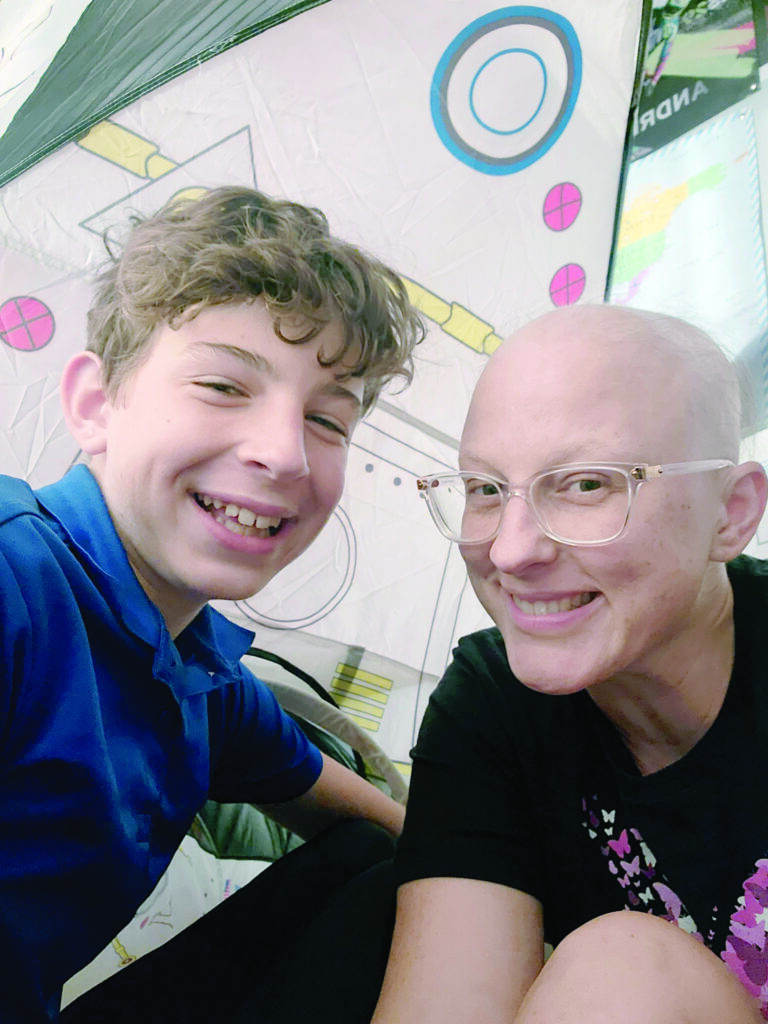
For Andrea Sitzes, the road through breast cancer began with a series of appointments that had repeatedly reassured her that the lumps and spots she felt were cysts.

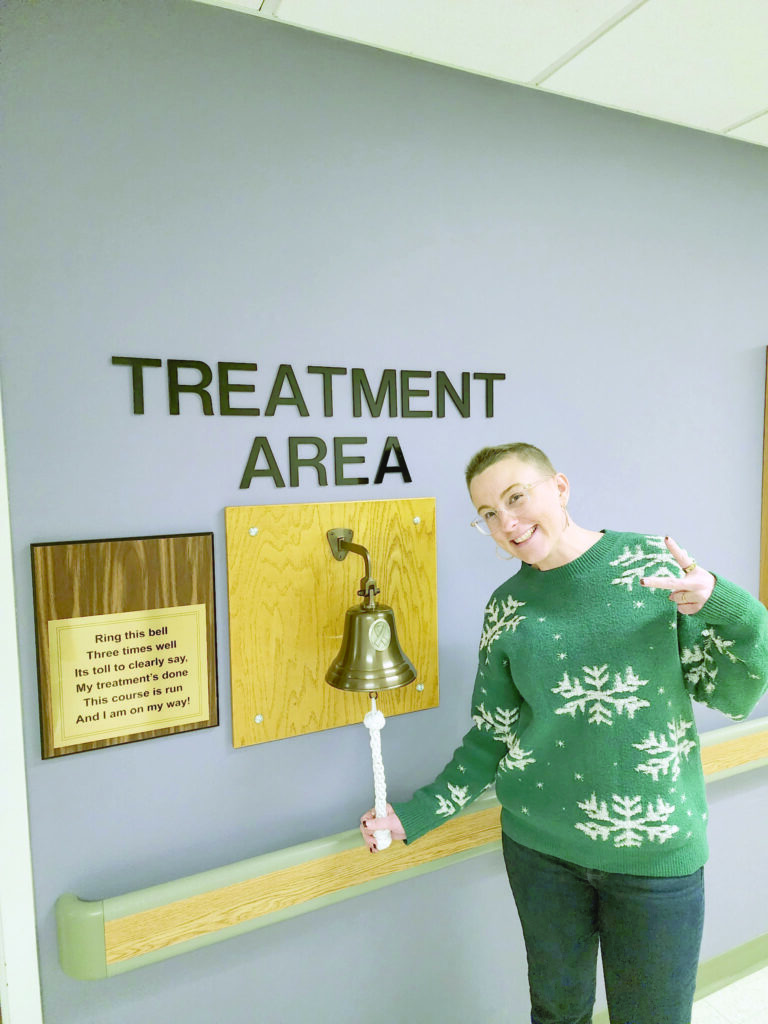
Then, at 36, a routine mammogram changed everything.
“My paternal grandmother was diagnosed with breast cancer when I was young,” Sitzes said. “She had a left mastectomy, but since that, she didn’t have to do any chemo radiation, no further treatment.
“Other than that, there was no family history. And I have also tested negative for all of the genes. So, I don’t have BRCA 1, BRCA 2. There is a myriad of others, but I have no genetic mutation.”
Sitzes has one son who, now 13, was 11 years old at the time of her diagnosis.
“My family’s been incredible,” she said. “In 2022 — in my early 30s — I started to have hormonal changes that led to some cystic changes.”
Sitzes said she had noticed a couple different lumps and spots.
“It was almost two solid years of every three to six months, going in, getting checked, doing ultrasounds, and biopsies,” she said. “In some cases they would be benign — all cystic.”
Sitzes said she thanks the Lord that she had already established care, because when she had the mammogram, they saw something irregular.
“It ultimately led to my diagnosis,” she said. “I didn’t feel a thing. What I learned through that early process is that I have extremely dense tissue, which should be the number one red flag.
“If there is a young woman that has dense tissue, push to establish care to get your screening done earlier.”
Sitzes said there is currently legislation that is aimed at getting the recommended age for mammograms lowered. For her, a scheduling change meant she didn’t get the scan at the time she had expected and she said that was a blessing.
“God just really opened the doors to be able to find this when we did,” she said. “You get a new vocabulary when you go through this. We knew of two small spots of Stage 0 or the DCIS (ductal carcinoma in situ in situ). And then we had also biopsied another spot on my right breast and then a lymph node that had lit up under my armpit.”
Sitzes said she then I discovered she had hormone positive (estrogen and progesterone positive) HER 2 negative breast cancer.
“I had a bilateral mastectomy in May of 2025,” she said. “My post-op pathology showed that the left was still clear, but my right had over 60 percent of my breast that was cancer affected, and I had a lymph node test positive. So, I got upgraded to what I fondly refer to as the VIP package.”
After this, Sitzes was referred to an oncologist, who recommended four months of dose dense chemotherapy.
“I had infusions every other week that was the equivalent of a three week dose,” she said. “That’s 24 weeks worth of chemo condensed into 16 weeks.”
Additionally, a PET scan after her surgery identified two lymph nodes inside her chest wall that were highly probable for metastatic spread.
“At that time, my oncologist said, ‘You know, if you would not have found this, you would not have made your 40th birthday,’” she said. “And 40, of course, is when they recommend mammograms.”
Sitzes said this is when she started to look at alternative treatments.
“Driving to my first oncology appointment, I just really felt that piece of God saying, ‘This is your path,’” she said. “I was very much taken down a road where I didn’t want to go, where I had to fully depend on God [without control].
“I think cancer is so widespread, so relevant because so many people have been touched by it, but it’s also so individual and that every case is different, how you treat it is different. What you choose to do as the patient is different. In my case, I very much got the peace after that point, like, okay, I’m going to have to go where I don’t want to go.”
Sitzes went through four months of chemo after her active treatment.
“Then I received a PET scan, and my first official report was October 13th of 2025 which said that those lymph nodes were completely resolved and no longer measurable,” she said. “Definitely a blessing from God.
“I had 15 radiation treatments in December and this year I have been on the path of, Additional medications.”
Sitzes said since her cancer is hormone positive and she isn’t of menopausal age, they have her on medications to suppress her hormones and she has been recommended for a hysterectomy as well.
When asked how that affects her in the terms of having more children, she said she and her husband hadn’t planned on having more children.
“We only have our one son, but I mean, you go through a 100,000 questions and it, it makes you then question everything,” she said. “You know, it’s not a peaceful journey to go through this.”
Sitzes is now in her second round of medical menopause.
“Chemo threw me into medical menopause for nine months,” she said. “Then after radiation, everything in my system restarted again. The oral medication was not strong enough, and so in April, I was switched to monthly injections to suppress my hormones. It’s been quite a battle with insurance, but, I was just notified that I will be having, finally, my full hysterectomy, November 2nd, and then I will have my final reconstruction and switch out my tissue expanders for my Implants December 7.”
Sitzes wants people to understand how different this journey is for everyone.
“In my case, there is no end,” she said. “My oncologist has told me I will never hear the words cancer free. I will never hear the words I’m in remission. Because she said, ‘The minute that I do that, we take the foot off the gas and I’m never willing to do that with you.’”
That was one of the harder adjustments to make in this process, as Sitzes said she is a goal oriented person.
“[Cancer free] is what you’re pushing for,” she said. “But then when you realize, okay, this is for my benefit. We’re going to stay vigilant. You just learn all along the way to adjust your expectations.
“That is kind of where I’m at now. Fear not, God is in control and walking in faith and realizing this is for my good.”
The follow-up treatment in Sitzes case is a targeted agent, which she refers to as “chemo pill sister.”
“It helps to suppress the remainder of the estrogen that is not taken care of by either surgery, or the injections, and I’ll be on that for 10 years.” She said. “In the beginning there was one test that came back and my estrogen was 300 percent higher than it should have been. I wish I had known then. That was probably my biggest early warning that I didn’t know was a warning at the time.”
Sitzes said she was always a healthy person who went to the doctor, worked out and she had been vigilant in her check ups.
“When the dominoes started to tip and when the test started to come back irregular, it just felt different,” she said. “The looks that I would get from the nurses felt different. Everything felt different. And then after my diagnosis, I remember thinking that I felt like tingles in my right breast.
“‘I think I feel this tingling. Do I really? Do I not? Am I making it up? It’s one of those things like you don’t realize it’s there until all of a sudden you’re hyper aware of those sensations in your body.”
Sitzes said she is a completely different human than she was two years ago.
“That is a process,” she said. “Relearning yourself, relearning your body, realizing that there is no back to normal. You have to create a new normal.
“Beauty has changed so much for me, when you stripped down everything that you, knew about yourself when you look at yourself and you don’t recognize yourself and it happens so fast.”
Another aspect that was majorly affected by this journey was motherhood.
“Feeling like the last of my son’s childhood was robbed from me was the absolute hardest,” she said. “I had a little boy when I was diagnosed and now my son is 13 and he’s taller than I am.
“We rode roller coasters for the first time the other day. But, I can’t describe to you in words how hard that is. You just have to lean on God.”
Sitzes said when you don’t know what to say to someone who is going through this, just say, “I’m here.”