Through the Years, Aug. 5
50 years ago
Aug. 11, 1976
— Airport business dominates Cassville council meeting
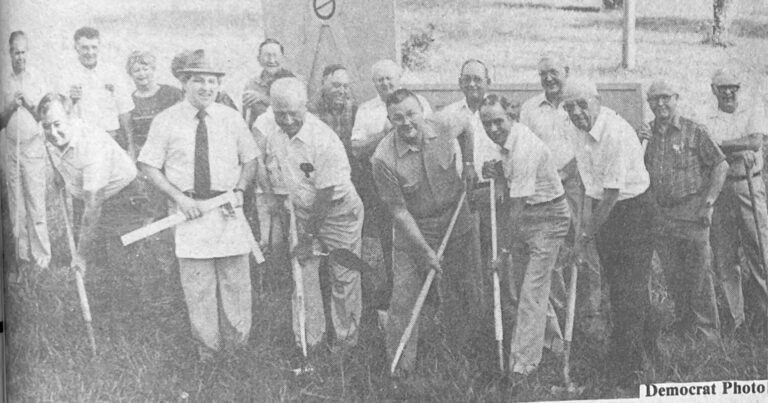
Review of airport business, something new for the City of Cassville, took a major portion of the Board of Aldermen’s time in its regular meeting Tuesday evening. Among the most important items were reports that approximately $20,000 of the $350,000 project budget would remain after construction of the $330,000 airport, including $12,000 in federal funds and $8,000 in state funds. Engineer George Ulmer said those savings could be used for future improvements. Mayor Bill LeCompte said the council authorized Ulmer to proceed with pre-application requests for funding to install lighting, a beacon and a visual approach slope through a 90-10 participation program with the Federal Aviation Administration. Plans for the airport dedication that Sunday and proposals from CASCO Developers and L.D. Brown for hangar construction were reviewed, with decisions on facilities deferred until legal contracts could be prepared. Other council business included receiving the annual audit report for discussion at the following month’s meeting; awarding Brown Ford Sales the lone bid for a new police car with a $2,088 trade-in allowance, leaving a difference of $3,580; rejecting an offer to purchase two surplus trucks; ordering updated insurance appraisals on city buildings and airport liability coverage; deciding not to replace the city park fence while supporting the South Barry County Jaycees in securing a non-flood-prone location; reviewing future plans for aviation fuel service at the airport with CASCO Developers; approving $1,200 for curb and drop-box work at the Neighborhood Center; and authorizing $700 to complete improvements to the former firehouse so it would match the Neighborhood Center renovations.
— Vanzandt graduates air traffic controller training
Airman First Class James E. Vanzandt, son of Mr. and Mrs. Leroy A. Vanzandt of Wheaton, graduated from the U.S. Air Force air traffic control operator course at Keesler Air Force Base, Mississippi, conducted by the Air Training Command. Qualified to regulate air traffic and direct aircraft to radar-controlled landings, Vanzandt was assigned to Wurtsmith Air Force Base, Michigan, for duty with a unit of the Air Force Communications Service. The airman was a 1975 graduate of Wheaton High School.
40 years ago
Aug. 13, 1986
— FASCO acquisition adds to Cassville plant workforce
Manufacturing of a firm on the east and west coasts of the U.S., acquired by FASCO Industries the previous September, would be moving to Cassville in the near future. In fact, the first truckload of machinery had already arrived at the local plant, according to Morris Castleberry, FASCO vice president and local plant manager. Castleberry said manufacturing consolidation of California and Connecticut plants of Torin Engineered Blowers would move swiftly over the next few months. “There will not be any significant addition of personnel immediately,” Castleberry said. “Additional people will be employed in early 1987 if current plans continue.” FASCO Cassville had added about 20 people to its employment list, bringing total payroll to 520 employees. The company planned no physical expansion, instead placing the new line equipment in existing space. Addition of Torin blowers would consist primarily of product assembly, with most parts purchased by contract, unlike FASCO blowers manufactured largely in Cassville. Castleberry said the product line, used extensively in business machines, would give FASCO another source for marketing, while engineering and sales forces would remain in California and Connecticut. He added that the company’s confidence in Cassville’s productivity and workmanship played an important role in selecting the local plant for consolidation. FASCO, a subsidiary of Hawker-Siddeley Companies of London, England, planned to begin consolidating the Torin lines on Oct. 1. Castleberry had spent much of the previous year coordinating the relocation of Torin offices in Chatsworth, California, and Torrington, Connecticut. Interior reconfiguration of the Cassville plant was underway to accommodate equipment arriving daily, with completion expected in early fall. Originally a Rochester, New York, company with South Carolina plants, FASCO first came to Missouri in Ozark before expanding to Cassville in 1975 through utility bond issues and industrial revenue bonds. The original 150,000-square-foot plant had since expanded three times and totaled 210,000 square feet on a 50-acre site along Sales Barn Road.
30 years ago
Aug. 7, 1996
— Epperly pulls ahead to win G.O.P. nomination for sheriff; lake area voters approve Eagle Rock-Mano-Golden fire district
The five-way contest for the Republican nomination for Barry County sheriff narrowed to a race between two candidates Tuesday night, with Mick Epperly and Randy Yarnall running neck-and-neck until the last precinct vote was tallied. Epperly was declared the winner with 1,335 votes, edging out Yarnall by a narrow 28-vote margin. Epperly will face incumbent Ralph Hendrix in the November general election. Hendrix, who was unopposed in the Democratic primary, garnered 848 votes. Bill Corn, William Heagerty and Charlie Long, the other candidates making a bid for sheriff on the Republican ballot, grabbed 272, 222 and 448 votes, respectively. In the only other contested race for county office, John Sullivan beat out opponents Don Chadd and Gene Robbins to become the G.O.P.’s candidate for southern commissioner. Sullivan attracted 1,002 votes to Chadd’s 838 and Robbins’ 259. Sullivan will go up against incumbent Red Edens in November. Edens earned 594 votes in the primary. Residents in the Eagle Rock, Golden and Mano communities voted in favor of establishing a fire protection district in the lake area. The final vote count was 318 in favor of the proposal and 177 votes against. By casting a “yes” vote, residents were giving the district’s board of directors permission to levy a property tax to support the district in an amount not to exceed 30 cents per $100 assessed valuation. Voters in the area also elected Cliff Mitchell (365 votes), Normal Hillyer (311), Richard Penfield (315), Oscar Wade (322) and Courtland (Corky) Nelson (323) to the first board of directors. Vote totals determined who would serve two-, four- and six-year terms on the board. Residents in the village of Butterfield overwhelmingly approved a $600,000 bond issue to construct a sewage system by a vote of 46 to 6. Voters countywide and in the cities of Cassville, Monett and Washburn rejected attempts to re-establish a local use tax. In the county, the issue attracted 1,475 “yes” votes and 1,760 “no” votes. Cassville’s issue lost with 136 ballots cast in favor and 266 against. The issue was narrowly defeated in Washburn by a vote of 26 to 27. In the race for sheriff, Yarnall and Epperly battled it out precinct by precinct. Yarnall carried 10 of the 21 precincts and Epperly captured nine. Epperly won by the widest margins in the precincts of Shell Knob and White River 2. Yarnall found his greatest support in the northern precincts of the county. Barry Countians went along with other voters in the 7th District, giving Roy Blunt the edge over Gary Nodler in the race for the G.O.P. congressional nomination. Blunt got 52.49 percent of the Barry County vote (1,853 votes) and Nodler received 47.51 percent (1,677). Blunt’s final vote tally in primary balloting was 39,277 votes to Nodler’s 31,210. Blunt will be running against Ruth Bamberger of Springfield, who topped the six-way race for the Democratic nomination, and Mike Harman of Dunnegan, the Libertarian candidate. In Barry County, Bamberger was the top vote-getter, capturing 408 votes. The G.O.P. race for state senator in the 29th District was also close among county voters. There were 1,759 votes cast for Wendell Bailey and 1,700 for Doyle Childers, who ended up capturing the Republican nomination in the race to fill the Senate seat vacated by retiring Sen. Emory Melton. Childers will face Democratic nominee D.J. Gross, who was unopposed in the primary. County voters didn’t pull any surprises when it came to votes cast for statewide offices. Republican voters in Barry County overwhelmingly supported Margaret Kelly, giving her 2,482 votes. Mel Carnahan captured 690 Democratic votes in the county. Rebecca Cook outdistanced challenger James J. Askew in the race for secretary of state on the Democratic ticket. In Barry County, Cook had 484 votes to Askew’s 324. Incumbent Cook will face Republican challenger John Hancock in November.
— City looks at issues facing wastewater treatment plant
Cassville aldermen turned their attention toward the city’s wastewater treatment facility at Monday night’s council meeting. Discussion centered around short- and long-term problems facing the treatment plant, which was converted last year from a lagoon disposal system to a liquid land application system. City Administrator Greg Beavers presented aldermen with a proposal from Bio-Tech Resources Inc., a company that would provide for placement of genetically engineered bacteria into the treatment system. The bacteria could work to clear up the majority of problems that currently interfere with efficient plant operations, Beavers said. Steve Henderson, wastewater treatment plant supervisor, said the introduction of genetically engineered bacteria into the water treatment system should achieve a number of positive results, including a reduction in the amount of grease in the system, a decrease in phosphate levels, fewer trips to the land application site and elimination of some of the natural bacteria that is harmful to the treatment system. The bacteria should also reduce the amount of manhours and costly chemicals used to clean the collection system. “In time, I believe the bacteria will make the sewer mains cleaner, thereby giving the plant more capacity,” Henderson said. “I believe it will more than justify the cost.” Bio-Tech is offering a 60-day trial period. If the bacteria does not produce the desired effects, the city would not pay the company a dime. If the bacteria works, the city would agree to pay the company $1,457 a month for its services. The genetically engineered bacteria is organically bred to target specific problems in the system, such as grease or phosphate accumulation. Henderson said the bacteria poses no human threat. “It’s a naturally occurring organism,” Henderson said. “It’s no super bug or anything.” The council deferred any action on the agreement with Bio-Tech until its Aug. 19 meeting. Aldermen planned to tour the treatment facility on Wednesday. According to both Beavers and Henderson, three other concerns faced the city’s treatment plant: removal of sludge from the 18.2-acre lagoon, where Henderson estimated a two-foot blanket of sludge would cost between $275,000 and more than $300,000 to remove; reduction of inflow and infiltration into the system, with the city planning a manhole rehabilitation program and sewer main inspections beginning the following year; and phosphate reduction, as Henderson expected the Department of Natural Resources eventually to impose a phosphate limit of 0.5 parts per million on treatment plants discharging into the White River Basin near Table Rock Lake. At the time, Cassville’s treated water contained 3 to 4 parts phosphate per million. Henderson said, “No one has a watertight system. We’ll start fixing what we can afford each year and eventually we hope to see a reduction in I and I (inflow and infiltration).”