Remembering the history of the 9/11 terrorist attacks
Monett program details development, aftermath
By Murray Bishoff Special to the Monett Monthly
History and personal recollections expanded into a detailed narrative about the Sept. 11, 2001 terrorist attacks in a memorial program presented on the evening of Sept. 11 at the Monett High School Performing Arts Center.
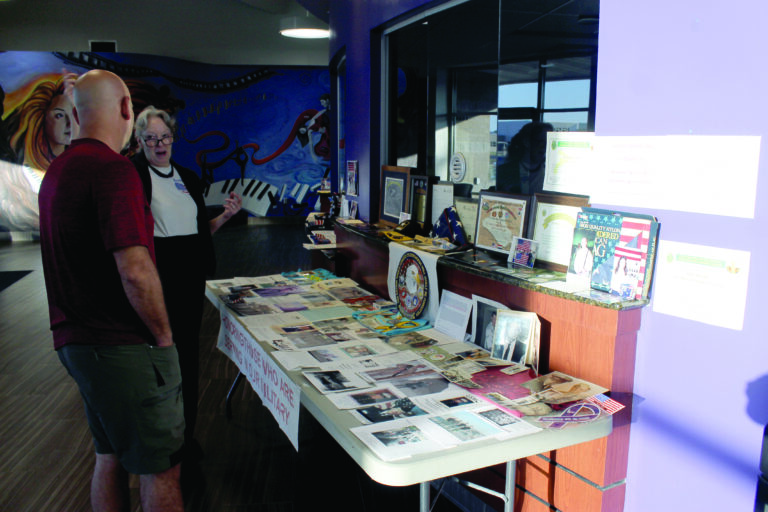
Organized by the Barry County Concerned Citizens, an offshoot of the Barry County Democrats, the event was non-partisan and focused on history. Those arriving had an opportunity to review memorabilia placed by Abby Hartin, a member of the area TLC Military Support Group, which grew out of the Veterans of Foreign Wars Post in Shell Knob. Hartin displayed letters from military personnel touched by the group in the aftermath of the terrorist attacks.
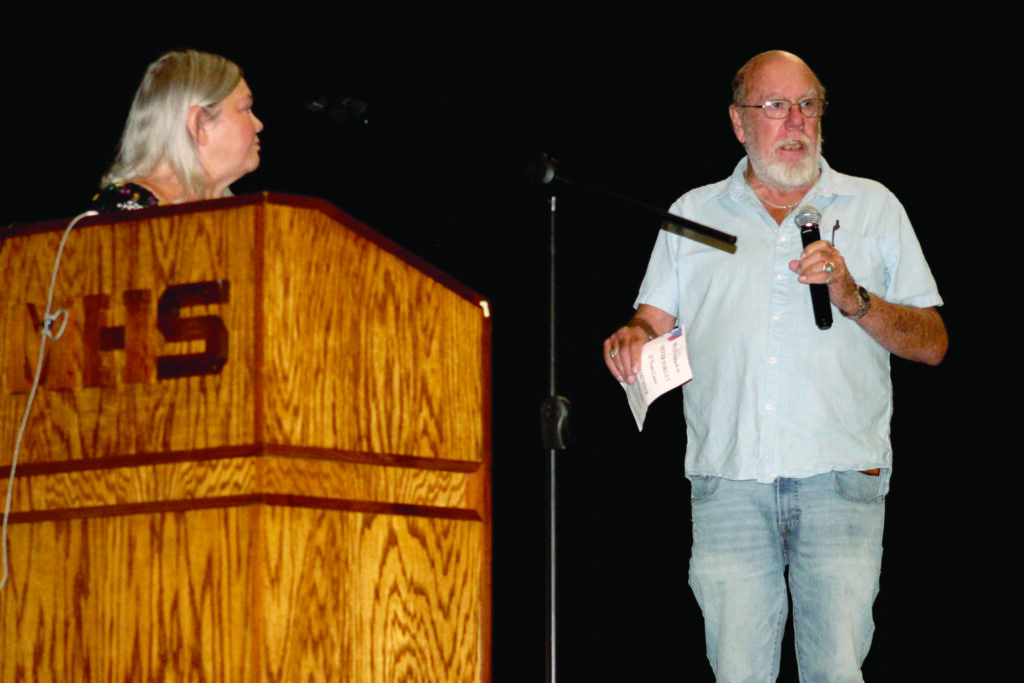
Brenda McKinney, a retired teacher from the Southwest school district, and Ron Monnig served as hosts for the event, speaking from the stage. Monnig noted the program served to remind the public of what happened and to focus on the work carried on by first responders today.
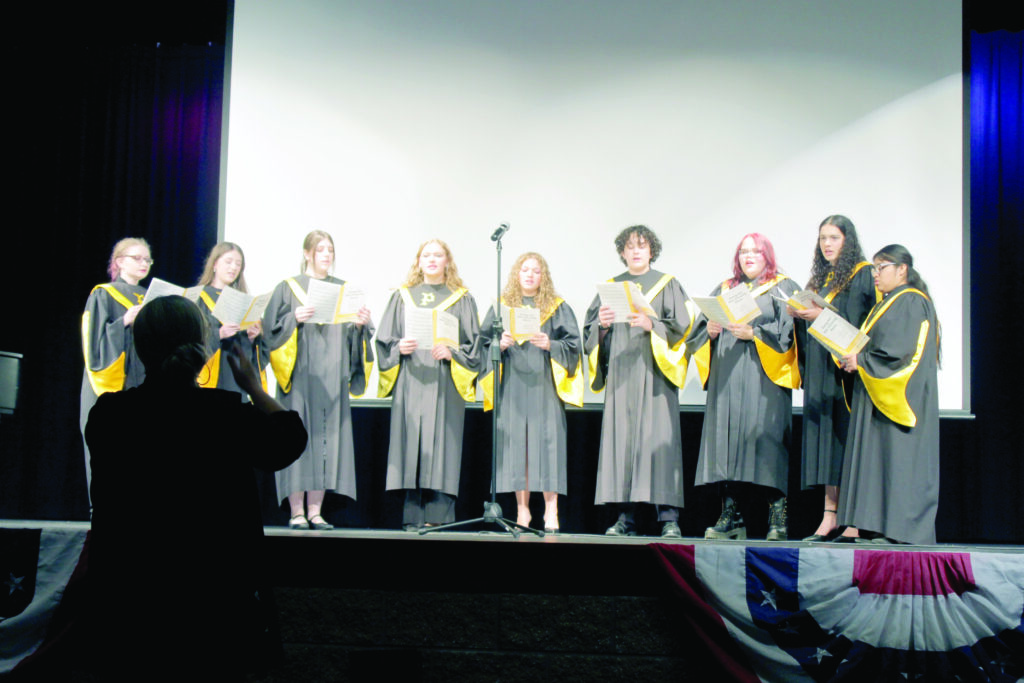
Bradley Bos, whose godmother perished in the terrorist attacks, presented the American flag. Allison Logan, a member of the Purdy High School choir, sang the National Anthem. McKinney contacted choir director Lauren Lee about having her ensemble participate, and nine members came. They sang “Song for the Unsung Hero,” which has a sing-along section.
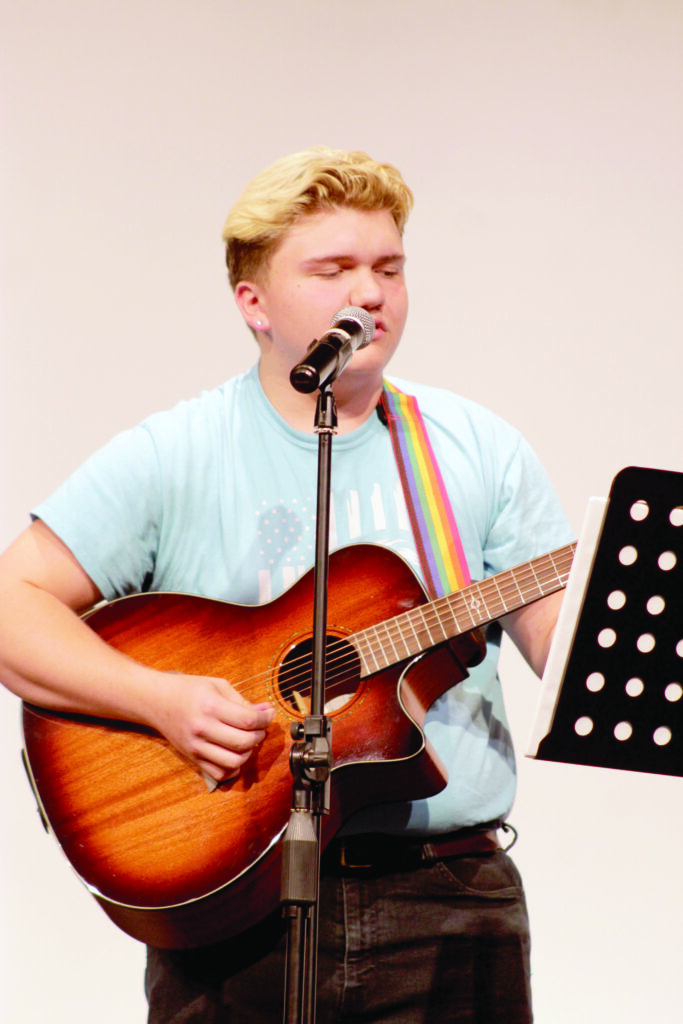
Christian Renfrow, a former student of McKinney’s, brought his guitar and sang “Remember the Day.”
During a break to deal with technical issues, members of the audience were invited to share their recollections of that day. Abby Hartin spoke about working at the Shell Knob Post Office that day. Jim Cabell, who lives in rural Miller, recalled being stranded at a conference in Chicago, renting a car to drive a friend to Kansas City then continuing back to Missouri.
Connie Jarvis of Monett spoke of working at the International Institute for Learning in Monett, which has an office in Manhattan. Her colleagues there were family and friends, and they all had connections to people lost that day.
Robert McGuire, a teacher at Monett Elementary at the time, recounted how parents that morning began appearing at school windows, checking on their children. The school, he recalled, chose to conduct school as usual, trying to make a normal day, while reassuring parents that conditions were normal, though teachers on break clustered around televisions to learn what was happening.
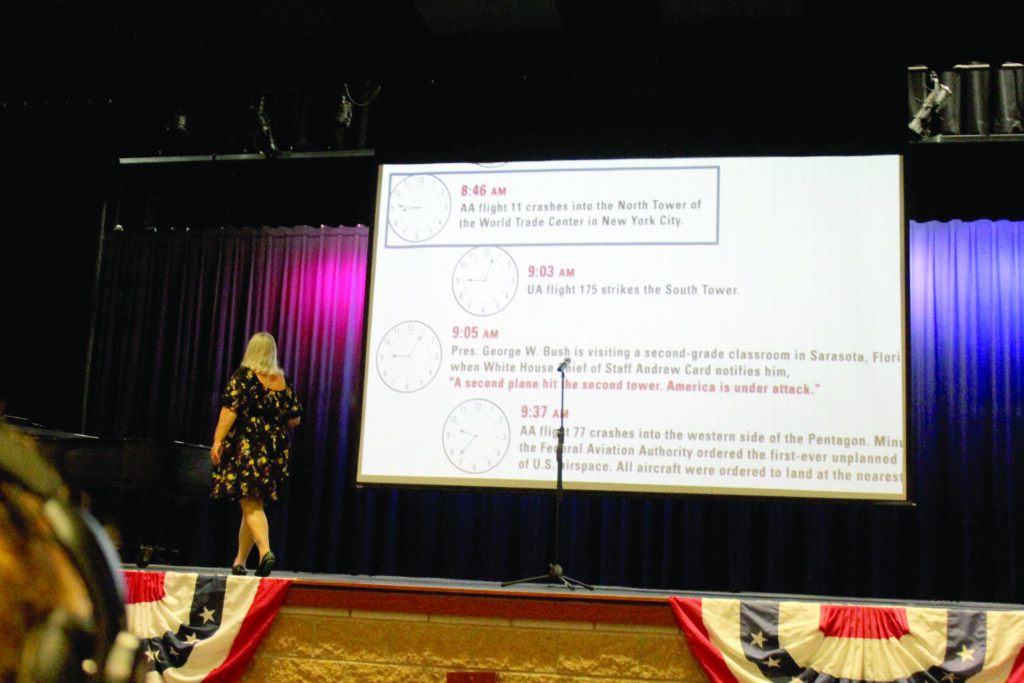
McKinney used projections to walk the audience through the story and timeline of each hijacked plane, when they departed and crashed. She detailed how the planes’ transponders were turned off, blinding officials to their locations and the times of the crashes. In recounting Flight 93, she noted Todd Beamer’s last recorded words, “Let’s roll,” as the passengers took over their plane and crashed it into a field at Shanksville, Penn., to prevent it from killing others.
She showed photos of those on board each plane.
Photos of the crashes, statistics of the death tolls adding up to 2,753 people in the planes and on the ground, the disaster response teams at work, had a cumulative effect. McKinney shifted to photos of the various memorials, including the seldom seen unique design at the Pentagon distinguishing those killed in the plane and those inside the building. Later memorials, such as the beams of light at the World Trade Centers, the bell tower at Shanksville, and international monuments in Israel, London, Italy, and one as close as College of the Ozarks, were also pictured.
The program lasted for 80 minutes, and would have run longer had McKinney’s videos played, but did not due to technical issues.
“This is a day for us to remember, and never forget,” McKinney said.
Monnig added that estimates put the number of people who have died from illness related to the destruction of the Twin Towers and the Pentagon at around 8,000, with many more unknown. He concluded the program by asking for a moment of silence, and to remember what it was like to have a great nation unified in spirit, as it was after the attacks.