
100 attend program on Monett caves
Legends, memories point to underground features
By Murray Bishoff Special to the Monett Monthly
The Monett Historical Society heard its first presentation on Monett’s caves at its July membership meeting.
A group of enthusiasts who launched the “Monett Muddy Cave” Facebook page has stimulated interest and discussion about reopening the known cave at South Park.
Monett’s caves, according to old newspaper accounts, are very different and seem to have been discovered at different times. Hardware dealer W.H. Floreth told the Monett Lions Club in 1947 about a sinkhole that opened on Broadway around Eighth Street around 1900 that led into a massive underground lake that the city tapped as a water source for several years.
The park cave seems to have been connected to a rock quarry dug into the hillside to extract limestone. Around 1908, a workman inside the quarry followed fissures that led to larger spaces. General use of the quarry ceased in 1918, according to a notice in The Monett Times, but was reopened in 1931, and its hole in the northeast hillside turned into the city dump until Mayor V.B. Hall had it closed in 1947. It is now believed to be under the park sledding hill.
Many stories have circulated about another entrance over the eastern edge of the park hill, close to the Boy Scout pavilion near the Kiwanis Club’s Kiddie Playground. Fencing for years warned parkgoers to avoid that location. This spot matches photos shared by the enthusiasts with old Scout photos believed to be by the entrance. Reports of cold air emerging from the ground by a rock-covered vertical section of the hillside have circulated as well.
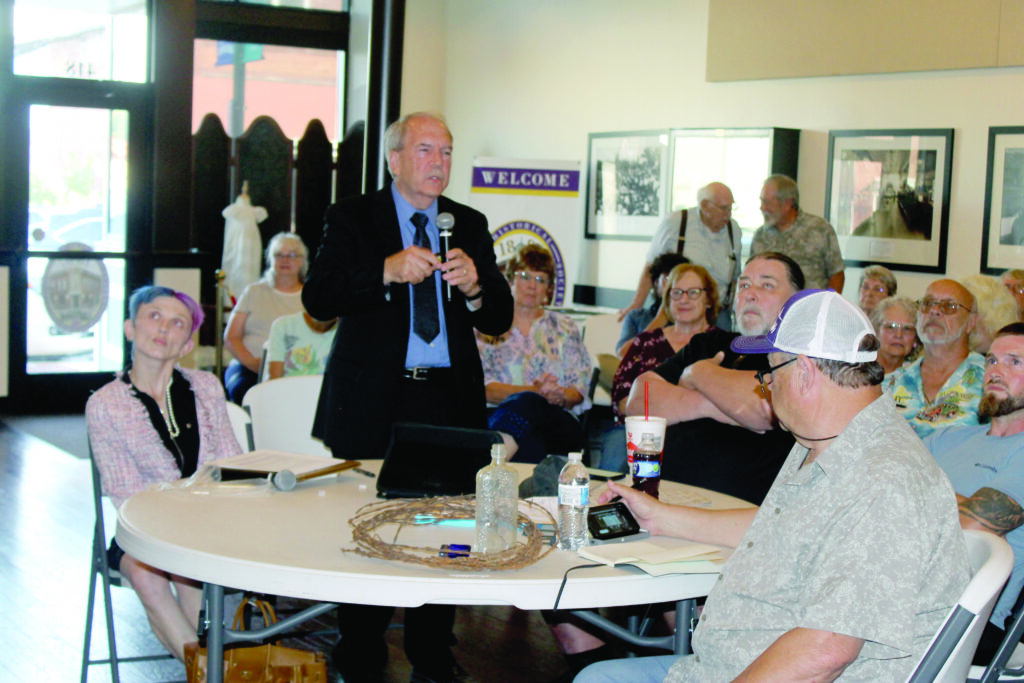
Mike Randall headed the group that included main contributors Robert Painter and Rusty Morris, both frequent online contributors. Morris said the group’s Facebook page presently has 808 followers. Elisabeth Hilton, who wrote the book “Beneath Missouri” about caves, also offered comments.
Stories about the caves are legion. The presentation focused on the South Park cave as potentially accessible. Randall admitted no eyewitnesses remain. Some, like self-styled historian Roy Howerton, said the cave was “nothing.” Others, Randall said, described “10-foot dropoffs that descended down a couple hundred feet at a 45-degree angle.” He showed a 1909 article from the Monett Star newspaper with a description of the “rock quarry cave.”
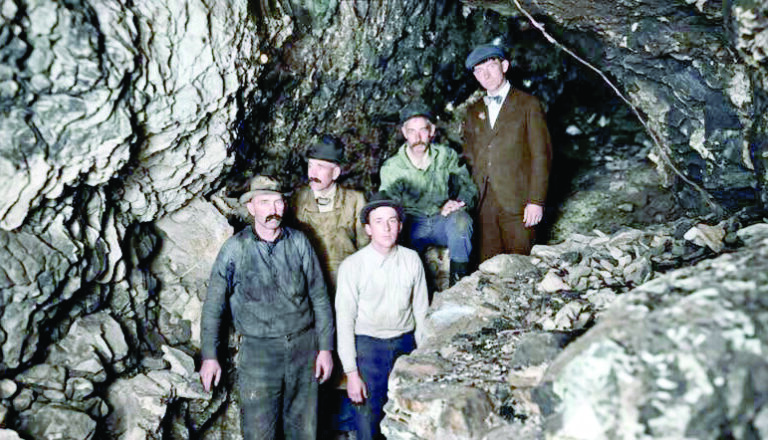
An undated photo, believed to have been taken between 1905 and 1909, showed Monett Times publisher D.A. Peters, pharmacist Logan McKee, and others identified as Will Dennis, Homer Counts and Fred King, exploring with a candle. These were leading citizens of the day, placing the legitimacy of the existence of the cave in their hands.
Other stories cited included William Bolton from 1941, retelling an event from his youth when he entered the cave, had his candle blown out, and only found his way out with the help of an Eveready-powered flashlight. Eveready used his letter in a national promotion. One audience member recounted stories shared by Monett’s Ford dealer, Les Mason, in his later years, vividly describing exploring the park cave as a Boy Scout with a Rev. Trotter.
While archeologist Lee Adams omitted Monett’s caves as locations of habitation by prehistoric settlers, Rex Mourglia commented he had found artifacts such as arrowheads in the adjacent creek bed. The farmer who plowed the nearby field, now part of the Windmill Ridge golf course, reported finding many similar stone artifacts over the years.
The most fantastic stories, long in circulation, described Logan McKee taking a boat into a cave and emerging somewhere east of Pierce City at a distance of several miles. It was noted that this story possibly conflates the downtown cave, known for holding water, with the park cave, which is not known for having a water source, though some have suggested a spring that originally filled the city park lake proves the cave had water. The water tower built in 1938 in the park, it was noted, had no well but was constructed as storage to fill the adjacent city swimming pool.
The park cave, as the city dump, is believed to hold the remnants of Logan McKee’s famous DeChenne airplane. Rod Anderson, a friend of the V.B. Hall family, recounted how Hall kept McKee’s plane hanging in the produce broker’s warehouse for years until the Hall’s youngest son, Ben, became old enough to gain an interest in aviation. At that point, Mrs. Hall told her husband to dispose of the plane, and it is believed to have ended up in the dump.
Morris offered photos showing school groups and families congregating near the quarry for picnics. Another spoke of finding tin cans and other debris in 1951, as a boy, near the dump entrance.
Hilton observed Missouri has 7,900 caves and listed the state’s 10 major caves considered major tourist attractions. She noted caves with sightless fish reflect pure water, whereas the lake under downtown Monett was abandoned as a water source when sewage from surface outhouses penetrated into it, threatening a typhoid outbreak.
City Commissioner Darren Indovina said the city would like to know more about what Monett’s caves have to offer.
“This is just the beginning,” Randall said. “Our vision is we hope to investigate with ERT [electrical resistivity tomography] and GPR [ground penetrating radar]. We want to go at it responsibly. We hope to map the cave system and create partnerships. We’re hoping to form a 501(c)3 [not-for-profit corporation] for this.”
“I think we have an opportunity to put another star on the map for Monett,” Anderson added.
Monett Historical Society President Jeanne Ann Camp invited the presenters to return for another round at a future date. Their program attracted around 100 visitors for the evening. The society will hold its next membership meeting on Tuesday, Aug. 18.