Monett caves again spotlighted
Technology to explore underground shared in discussion
By Murray Bishoff Special to the Monett Monthly
A second program on Monett’s caves offered technical information on exploration as enthusiasts pondered how to access and penetrate the legends of subterranean Monett.
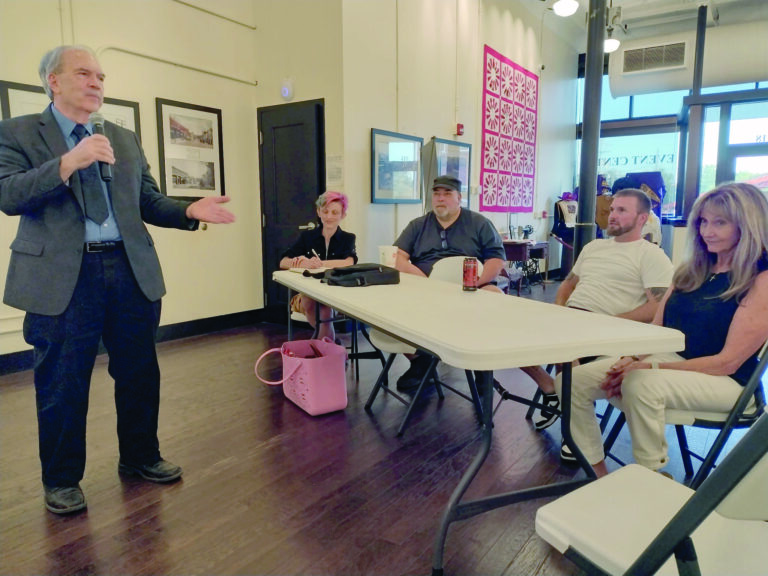
Mike Randall, Robert Painter and Rusty Morris returned to the Monett Museum for more conversation at the Sept. 15 membership meeting of the Monett Historical Society. This time Randall had Dr. Katherine Grote, an associate professor in geological engineering at Missouri University of Science and Technology in Rolla, on a Zoom connection to offer information on ground penetrating radar as well as electrical resistivity tomography and imaging.
Grote provided several PowerPoint slides explaining these tools. Electrical resistivity, she noted, uses electrical current to penetrate the ground and send back patterns based on subsurface materials. Metal electrodes are placed in the ground and receive currents shaped by different soil, and geological formations. Air, she noted, is an electrical insulator that can be detected in underground voids. It shows up differently than surrounding rock and soil. Water-filled voids appear as anomalies with low resistivity. Groundwater systems dissolve solids that conduct electricity easily.
Ground penetrating radar uses high frequency radio waves to create images. Grote reported the industrial use for this tool falls primarily in detecting underground utilities, pipes and rebar, as well as geological structures. She conceded that interpreting data from these machines can be “tricky.” However, she noted the equipment can be used inexpensively and covers large areas easily. It will not, however, work well in a clay-rich environment. Its major disadvantage stems from its limited range.
Randall, who led the discussion, emphasized that these tools could help identify the location of the stone quarry under the sledding hill at South Park and find other access points. He observed that every time he goes to South Park, he sees people walking along the bluff and the dirt path that cuts through the wooded area above the soccer fields.
Rusty Morris further stressed the path offers links to the underworld. He observed a hand-held thermometer can measure temperatures in the 90s on rocks on the edge of the path. Moving south, toward the middle of the path paralleling the soccer fields, temperatures dip to the 80s and as low as 75 toward the Scout picnic pavilion near the Kiddie Playground, a site believed by many to be the most accessible entrance to the caves themselves. Steam is not evident coming from the ground, but on a humid day, rocks can be seen “dripping” moisture. Audience members asked about other cave-related signs. No bats, however, had been seen around the potential cave entrances.
Robert Palmer, who works at the park, recounted how on Sept. 9, he lowered an endoscopic camera into a hole through some poured concrete to a depth of three-and-a-half feet. The camera brought back blue reflective images, suggesting water. This challenged past stories that the cave at South Park was simply dry, unlike the cave under Broadway, known initially as a water source. Painter noted that under present dry summer conditions, the reflected image had to be water.
Randall suggested studying historic photos and lining them up with unchanged geologic formations at the park. These, he felt, verified the existence of the caves. He spoke about potential for tourism if the caves could be entered. He cited the Mark Twain Cave in Hannibal, the Roanoke Park Cave in the Kansas City area, the Top of the Rock Cave, south of Branson, and the cave at Jolly Mill, west of Monett. The Jolly Mill cave has a steel grill door covering its entrance, erected by the Missouri Department of Conservation to keep people out but to allow access by bats, a subject of major interest to state researchers.
Morris spoke about his contact with an agent from the Department of Conservation that could enable him to accompany a trip into that cave.
Randall summarized the assorted legends about the caves, the prominent community leaders who explored them, the alleged connection to other underground channels that led by boat toward Pierce City. Randall teased the audience about a strategic plan he could unveil at a later date, involving formation of a not-for-profit organization to spearhead cave development and partnerships needed to advance the plan, including pursuing grants.
He invited those seeking more information to view the group’s Monett Muddy Cave page on Facebook, and view Morris’s Barry and Lawrence Counites History and Mysteries posts.
The Monett Historical Society offers monthly meetings on the third Tuesday on the month at the Events Center at 320 E. Broadway.